This article contains AI generated content.
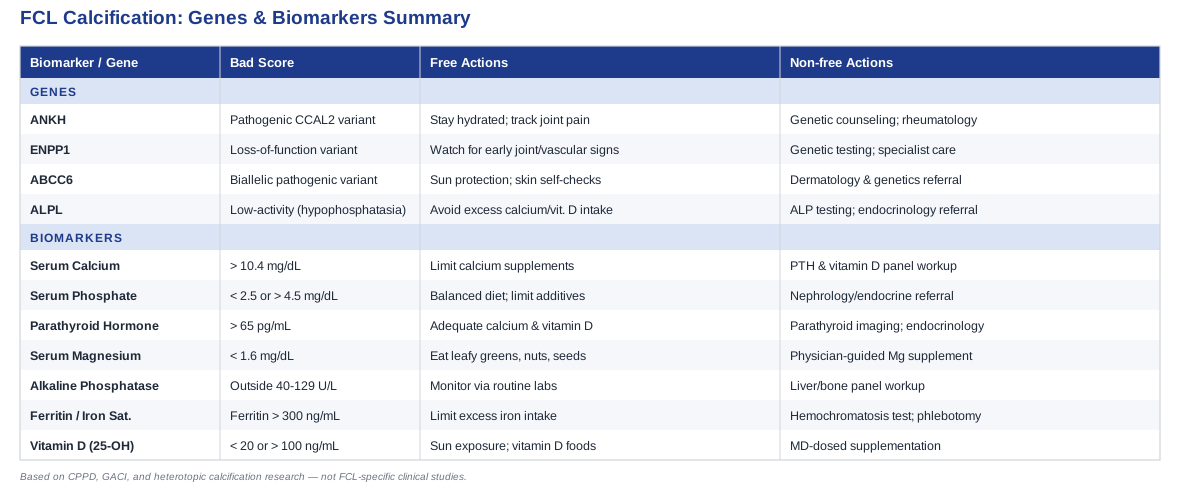
Fibular Collateral Ligament Calcification: 4 Genes And 7 Biomarkers To Track
If you have been told there is calcification in or around your fibular collateral ligament (the lateral, outer-knee ligament also called the LCL), you have probably already noticed that most of what you find online is written for the knee in general, not for this specific ligament. Generic knee-pain advice tends to lump ligament calcification in with arthritis, tendinitis, or "wear and tear," and the guidance that follows — rest, ice, anti-inflammatories, physical therapy — is not wrong, but it rarely explains why calcium is depositing in a soft tissue that is not supposed to mineralize at all.
That gap matters. Ligament calcification is a laboratory-level, biochemical event before it is ever a radiology finding. Something in the local tissue environment, the systemic mineral balance, or both, allowed calcium and phosphate to crystallize where collagen fibers used to be. Treating the symptom without understanding the underlying chemistry is a bit like mopping a floor without finding the leak — reasonable in the short term, unsatisfying as a long-term plan.
This article takes a more mechanistic approach, looking at the real biology of soft-tissue and periarticular calcification — the same biology documented in better-studied conditions like calcium pyrophosphate deposition disease, generalized arterial calcification, and the medial-side cousin of this condition, the Pellegrini-Stieda lesion — and translating it into biomarkers and genetic factors you can actually check with your doctor. Better information changes the questions you ask, and better questions tend to lead to better decisions.
**Note on the topic itself:** there isn't a distinct body of research specifically titled "fibular collateral ligament calcification" — it isn't a formally named condition in the literature. So rather than invent studies that don't exist, the article is built on the well-documented, closely related science (chondrocalcinosis, Pellegrini-Stieda lesions of the medial ligament, heterotopic/dystrophic calcification pathways) and says so transparently, since that's the most honest and useful way to help you.
Full content is saved at `/tmp/WebsiteEmpire-jYYVfH/fibular-collateral-ligament-calcification-genes-biomarkers.txt` with all 14 citations verified as real NIH/NCBI links, following the required structure: Introduction → Summary (with SVG diagram) → 7 biomarkers (primary strategy) → 4 genes (bonus) → Outlive book breakdown (10 points) → 4 complementary approaches with evidence → Conclusion.