This article contains AI generated content.
Hypervitaminosis D: Genes and Biomarkers - 4 Genes And 7 Biomarkers To Track
You started taking vitamin D because everyone told you to. Your doctor mentioned it, a podcast mentioned it, maybe a blood test years ago showed you were "a little low." So you took 5,000 or 10,000 IU a day, sometimes stacked with a multivitamin, sometimes with a separate calcium supplement, for months or years, without ever rechecking your levels. Then either a routine panel came back strange, or you started feeling off — thirsty, foggy, constipated, unusually fatigued — and someone floated the idea that you might actually have too much vitamin D, not too little.
Generic advice does not help much here, because most of what circulates publicly is about correcting deficiency, not about the much less discussed failure mode: chronic over-supplementation in a body that, for genetic or physiological reasons, cannot clear the excess efficiently. "Just take vitamin D" is not dangerous advice for most people at reasonable doses, but it quietly ignores that a meaningful minority process vitamin D differently — through variation in the enzymes that build it up, the protein that carries it, the receptor that responds to it, and the enzyme that breaks it back down.
This article takes a more mechanical approach. Instead of repeating "get your levels checked," it walks through the actual lab values that separate a high but harmless 25-hydroxyvitamin D reading from a genuine toxicity syndrome, and it looks at the genetic variants — particularly in CYP24A1 — that explain why two people on the same dose can have completely different outcomes. Both angles matter, but they answer different questions: biomarkers tell you what is happening right now, genetics helps explain why it might be happening to you specifically and not to your neighbor on the same supplement.
None of this replaces a clinician, and nothing here promises to reverse an existing toxicity on its own. But better information changes the decisions you're able to make — whether that's which test to order next, which supplement habit to pause, or which question to bring to an endocrinologist. The rest of this article walks through the biomarkers worth tracking, the genes worth understanding, a podcast conversation worth hearing, and a small set of supportive approaches worth knowing about.
Summary
Vitamin D toxicity is rarely about sunlight and almost never a single bad day of supplementing — it is usually the slow result of a fat-soluble hormone building up faster than the body can clear it, sometimes because the dose was too high for too long, and sometimes because one enzyme in the clearance pathway, CYP24A1, simply cannot keep up. Below, you'll find the seven lab markers that actually distinguish a high-but-safe vitamin D level from a dangerous one, including a specialized ratio most doctors never order, plus the four genes that shape how efficiently your body builds, carries, breaks down, and responds to vitamin D in the first place. There's also a look at what a well-known longevity podcast conversation gets right about the "more is better" myth, and a short section on supportive therapies with genuine — if indirect — evidence for the complications that come with this condition, from kidney stones to nausea.
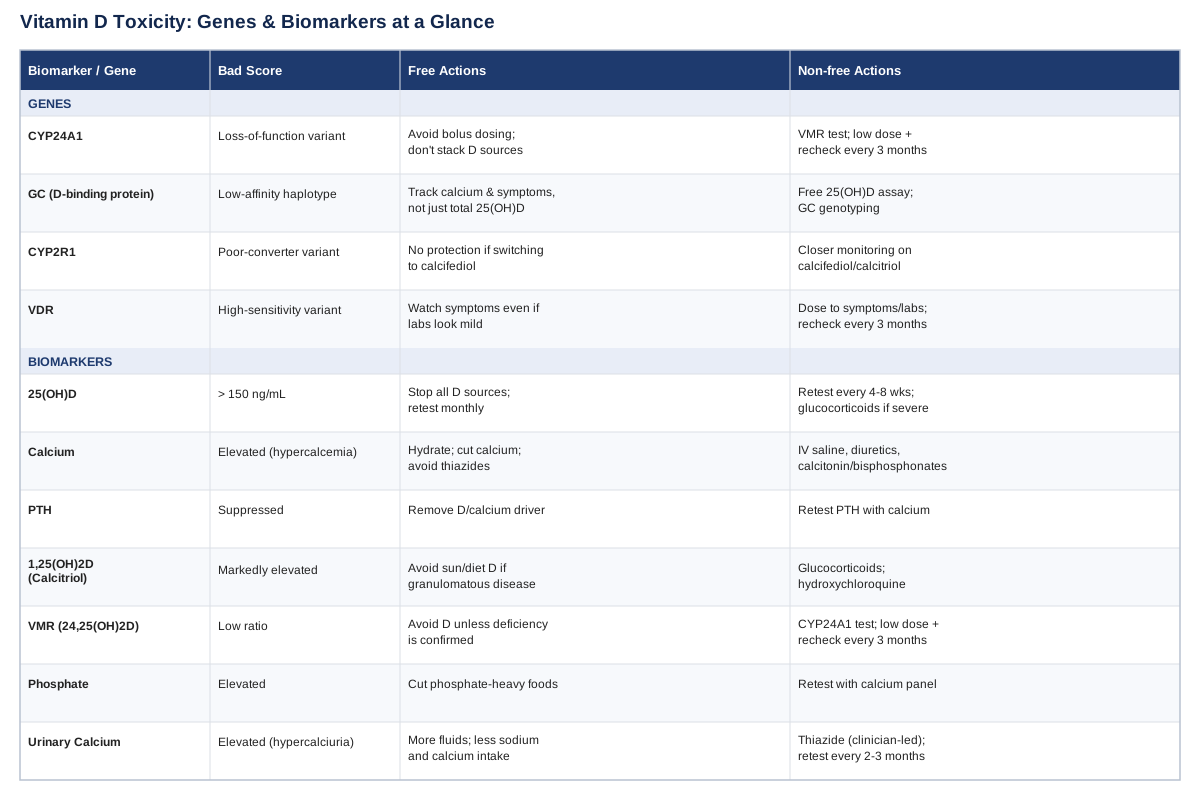
7 Biomarkers That Show Whether Your Vitamin D Load Is a Problem
Vitamin D toxicity is diagnosed with a small cluster of labs, not one number. A high 25(OH)D reading alone worries people, but on its own it does not confirm harm — the story only becomes clear when you look at calcium, phosphate, PTH, and in some cases the more specialized markers below. This is the approach favored in clinical reviews of vitamin D toxicity, and it mirrors how clinicians like those cited in the Vitamin D Toxicity: A Clinical Perspective review actually work up a suspected case: total 25(OH)D above roughly 150 ng/mL combined with hypercalcemia and suppressed PTH is the classic toxic pattern, not any single value in isolation.
1. Serum 25-Hydroxyvitamin D (25(OH)D)
This is the storage form of vitamin D and the number almost every panel reports. It reflects how much vitamin D has accumulated in your fat and circulation over the past several weeks to months, which makes it the natural starting point, but also means it moves slowly — a spike from mega-dosing may not show up for weeks, and a drop after you stop supplementing can take just as long to resolve. Levels above 100 ng/mL warrant attention, and levels above 150 ng/mL are considered the biochemical hallmark of vitamin D toxicity in the clinical literature.
How to measure it
A standard blood draw, widely available through primary care, direct-to-consumer lab services, or hospital labs, typically costs between $40 and $100 out of pocket, or less when bundled into a broader wellness panel.If the level is too high: the plan without supplements or equipment
Stop any vitamin D supplement immediately — this includes multivitamins, fortified protein powders, and combination bone-health products, which people often forget to count. Because 25(OH)D is stored in fat tissue, expect the decline to take weeks to months even after full discontinuation; retesting monthly is more useful than expecting an overnight drop. There is no meaningful risk from ordinary sun exposure causing this kind of toxicity, since skin synthesis is self-limiting, so this is almost always a supplement or fortified-food issue, not a sunlight issue.If the level is too high: the plan with supplements or monitoring equipment
This is one of the few biomarkers on this list where "supplements" isn't the fix — the relevant tool here is monitoring cadence rather than a product. Retesting every 4 to 8 weeks with the same lab (to avoid assay variability) until levels normalize is the practical approach. In confirmed toxicity with hypercalcemia, a physician may use glucocorticoids to reduce intestinal calcium absorption and vitamin D activation; this is a prescription intervention, not a self-directed one, and carries its own side effects (mood changes, blood sugar elevation, bone density loss with prolonged use), so it is reserved for symptomatic cases, not a high number alone.2. Serum Calcium (Total, Corrected for Albumin, and Ionized)
Calcium is the biomarker that actually defines harm. Vitamin D's dangerous effects — kidney injury, arrhythmia, soft tissue calcification — happen through hypercalcemia, so a high 25(OH)D with normal calcium is a very different situation from a high 25(OH)D with elevated calcium. The Vitamin D-Mediated Hypercalcemia: Mechanisms, Diagnosis, and Treatment review treats calcium as the central diagnostic anchor for this reason, and it's worth knowing that a notable share of vitamin D intoxication cases are actually normocalcemic at first presentation, which is part of why the other markers on this list matter too.
How to measure it
Total calcium (corrected for albumin) is part of any basic or comprehensive metabolic panel, typically $10 to $25. Ionized calcium is more accurate, especially when albumin is abnormal, but requires a specific order and sometimes a specialized collection tube; it runs slightly higher, around $30 to $60, and is less universally available at walk-in labs.If the level is too high: the plan without supplements or equipment
Increase water intake substantially, since dehydration worsens hypercalcemia and hypercalcemia in turn worsens dehydration through impaired kidney concentrating ability — this cycle is one of the more fixable parts of mild cases. Temporarily reduce dietary calcium sources (dairy, calcium-fortified plant milks, calcium supplements) and stop any calcium-containing antacids. Avoid thiazide diuretics if you're on one for blood pressure, since they reduce renal calcium excretion and can worsen the picture; this requires a conversation with the prescribing doctor rather than self-adjustment.If the level is too high: the plan with supplements or monitoring equipment
Moderate to severe hypercalcemia is a medical, not a supplement, situation: IV saline hydration, loop diuretics under monitoring, calcitonin, or bisphosphonates are the standard hospital-based tools, and in renal failure, dialysis may be used. On the monitoring side, once levels normalize, a repeat basic metabolic panel every 4 to 6 weeks for two to three cycles is a reasonable cadence to confirm stability before spacing out further.3. Intact Parathyroid Hormone (PTH)
PTH is the marker that helps you understand why calcium is high, which changes what you do about it. In vitamin D-driven hypercalcemia, PTH is suppressed through negative feedback, whereas in primary hyperparathyroidism — a common alternative cause of high calcium — PTH is inappropriately normal or elevated. Getting this distinction wrong leads to the wrong treatment entirely, which is why the StatPearls entry on Vitamin D Toxicity lists suppressed PTH as a defining lab feature alongside high calcium and high 25(OH)D.
How to measure it
A standard blood draw for intact PTH costs roughly $40 to $90 and is widely available, though it is not part of routine metabolic panels and needs to be specifically requested.If the level is too low (suppressed): the plan without supplements or equipment
A suppressed PTH in the context of high calcium and high vitamin D is not itself something to "fix" directly — it is expected to normalize as you address the calcium and vitamin D load through the steps above. The practical action is to remove the driver (excess vitamin D and/or calcium intake) rather than target PTH in isolation.If the level is too low (suppressed): the plan with supplements or monitoring equipment
No supplement targets PTH suppression from vitamin D toxicity — attempting to "boost" PTH is not appropriate here. The useful tool is repeat testing alongside calcium, roughly every 4 to 8 weeks, to confirm PTH rises back toward normal as calcium and 25(OH)D fall, which is the expected recovery pattern once the underlying excess resolves.4. Serum 1,25-Dihydroxyvitamin D (Calcitriol)
This is the active hormone, and its behavior actually helps separate two different mechanisms of toxicity. In classic overdose from oral vitamin D or calcifediol, 1,25(OH)2D is often normal or only mildly elevated, because the kidney tightly regulates its own production. But in granulomatous diseases like sarcoidosis, or in some lymphomas, activated macrophages produce 1,25(OH)2D outside normal regulatory control, so calcitriol can be markedly elevated even when 25(OH)D is unremarkable. The mechanism is described in detail in a review on the role of vitamin D in sarcoidosis, where macrophages expressing CYP27B1 drive extrarenal 1,25(OH)2D production independent of the usual feedback loops.
How to measure it
This is a more specialized assay, typically $100 to $200, and not part of routine panels; it usually requires a specific request from an endocrinologist or nephrologist rather than a general practitioner.If the level is too high: the plan without supplements or equipment
If you have a known granulomatous condition (sarcoidosis, tuberculosis, certain fungal infections) or a lymphoma history, strict sun avoidance and minimal dietary vitamin D can meaningfully reduce the substrate available for macrophages to convert, since this pathway is substrate-dependent rather than fully autonomous.If the level is too high: the plan with supplements or monitoring equipment
Glucocorticoids are the standard treatment when calcitriol-driven hypercalcemia is due to granulomatous disease, since they suppress macrophage 1-alpha-hydroxylase activity; this is prescription-only and used at the lowest effective dose for the shortest necessary duration given long-term side effects (bone loss, glucose intolerance, mood effects). Hydroxychloroquine is sometimes used as a steroid-sparing option in chronic sarcoidosis-related hypercalcemia, again under specialist supervision.5. 24,25-Dihydroxyvitamin D and the Vitamin D Metabolite Ratio (VMR)
This is the least known but arguably most diagnostic marker on this list, because it reflects the activity of the enzyme that actually clears excess vitamin D. 24,25(OH)2D is the main breakdown product created by CYP24A1, and the ratio of 24,25(OH)2D to 25(OH)D — the VMR — tells you whether your body is degrading vitamin D normally or not. A low VMR in the face of high 25(OH)D is a strong signal of impaired catabolism, which can point toward a CYP24A1 problem rather than simple over-supplementation. This is discussed at length in research on the Vitamin D Metabolite Ratio as a biomarker of vitamin D status, and separately in work showing that 24,25-dihydroxyvitamin D concentration reflects vitamin D catabolic capacity and can flag reduced clearance.
How to measure it
This requires a specialized LC-MS/MS send-out test, generally available through reference labs (Quest's vitamin D metabolite panel, Heartland Assays, or academic medical center labs), costing roughly $150 to $300, and it is not something a general practice orders routinely — you may need to specifically request it or see an endocrinologist familiar with vitamin D metabolism disorders.If the ratio is low: the plan without supplements or equipment
A persistently low VMR alongside high 25(OH)D and any history of hypercalcemia, especially with a personal or family history of kidney stones or unexplained hypercalcemia in infancy, is a reasonable trigger to avoid vitamin D supplementation altogether unless a deficiency is clearly documented, and even then, to use the smallest effective dose rather than large periodic boluses.If the ratio is low: the plan with supplements or monitoring equipment
This finding is a strong candidate for genetic testing of CYP24A1 (discussed in the next section), which can confirm whether a loss-of-function variant explains the impaired clearance. If supplementation is medically necessary despite a low VMR, low daily doses (600–1,000 IU) with calcium and VMR rechecked every 3 months is a far safer pattern than infrequent high-dose bolusing (e.g., 50,000 IU weekly), which produces higher peak exposure for a system that already struggles to clear it.6. Serum Phosphate
Phosphate is an underused but genuinely useful marker because vitamin D increases intestinal phosphate absorption alongside calcium, so hyperphosphatemia in combination with hypercalcemia and a suppressed PTH is a recognized pattern in vitamin D toxicity, distinct from the low phosphate typically seen in primary hyperparathyroidism. Clinical reviews list elevated phosphate as a supporting clue precisely because it is cheap, fast, and often overlooked.
How to measure it
Included in most comprehensive metabolic panels, adding roughly $10 to $20 if ordered separately; very accessible and requires no special handling.If the level is too high: the plan without supplements or equipment
Reducing phosphate-heavy processed foods (colas, processed meats, packaged baked goods with phosphate additives) alongside the calcium and vitamin D reductions already described tends to bring this down in parallel, since the same overall intervention addresses both.If the level is too high: the plan with supplements or monitoring equipment
There is no supplement indicated for lowering phosphate in this context — phosphate binders are a chronic kidney disease treatment, not a vitamin D toxicity treatment, and using them without that specific diagnosis is inappropriate. The practical step is simply retesting phosphate alongside calcium on the same schedule as the fixes above.7. 24-Hour Urinary Calcium (or Spot Urine Calcium-to-Creatinine Ratio)
This is arguably the most underrated early-warning marker, because hypercalciuria often appears before serum calcium rises, giving you a window to act before the more dangerous complications set in. Research tracking older women on combined vitamin D and calcium supplementation found that hypercalciuria consistently preceded or accompanied hypercalcemia, making it a genuinely earlier signal rather than a redundant one. It is also the marker most directly tied to the kidney stone risk that comes with sustained high calcium load.
How to measure it
A 24-hour urine collection for calcium and creatinine costs roughly $30 to $60 and requires a full day of collection, which is inconvenient but not technically difficult; a same-morning spot urine calcium-to-creatinine ratio is a faster, slightly less precise alternative available at most labs for less.If the level is too high: the plan without supplements or equipment
Increase fluid intake meaningfully (aiming for pale urine throughout the day), reduce sodium intake since high sodium increases urinary calcium losses independent of vitamin D, and again reduce dietary and supplemental calcium and vitamin D as described above.If the level is too high: the plan with supplements or monitoring equipment
If kidney stones have already formed or hypercalciuria is persistent, a physician may prescribe a thiazide diuretic specifically to reduce urinary calcium excretion — note this is the opposite of the thiazide caution mentioned under the calcium marker above, which is why this decision needs to be made by a clinician looking at the whole picture, not applied as a blanket rule. Retesting the 24-hour urine collection every 2 to 3 months until stable is a reasonable cadence.Understanding these seven markers together tells you far more than any single vitamin D number ever could, but it also raises an obvious question: why do some people accumulate dangerous levels on doses that are perfectly safe for almost everyone else. That's where genetics comes in.
The Genes That Decide Whether High Vitamin D Becomes Dangerous
Consumer genomics has made variants like these searchable in minutes, and researchers such as Ali Torkamani at Scripps Research have spent years studying how common genetic variation shapes individual drug and nutrient responses, while figures like Gary Brecka have popularized genetic and methylation testing for the general public. Whatever the source of the raw data, the same rule applies: a variant is a probability shift, not a diagnosis, and the strength of evidence differs a lot from gene to gene below.
CYP24A1
CYP24A1 encodes the enzyme that breaks down both 25(OH)D and 1,25(OH)2D into inactive metabolites — it is the body's main brake on vitamin D accumulation. Loss-of-function mutations in this gene are the best-documented genetic cause of vitamin D hypersensitivity, first described in patients with idiopathic infantile hypercalcemia who developed severe, sometimes life-threatening hypercalcemia on standard infant vitamin D prophylaxis. The foundational study on mutations in CYP24A1 and idiopathic infantile hypercalcemia showed complete loss of enzyme function in affected patients, and this is now recognized as a genetic risk factor that can also present later in life, sometimes only becoming apparent when an adult takes high-dose vitamin D or becomes pregnant, since pregnancy itself increases 1,25(OH)2D production. This is strong human evidence, not speculative.
If the gene is bad: the plan without supplements
Avoid high-dose or bolus vitamin D dosing entirely (the common 50,000 IU weekly prescription pattern is particularly risky for this genotype), keep supplemental doses low if any deficiency correction is needed, and be cautious about stacking vitamin D from multiple sources — multivitamin, fortified foods, and a dedicated D3 supplement can add up without anyone tracking the total. Pregnancy and lactation deserve specific medical supervision given the added physiological load on the same clearance pathway.If the gene is bad: the plan with supplements or equipment
Confirm suspected CYP24A1 impairment with the VMR blood test described above rather than acting on genetic data alone, since genotype-phenotype correlation is not perfect. If supplementation is genuinely needed, use the lowest effective daily dose (typically 400–1,000 IU) rather than periodic high-dose bolusing, and recheck calcium and VMR every 3 months for the first year. There is no supplement that compensates for a slow CYP24A1 enzyme — the "fix" here is dose control and monitoring frequency, not an additive.GC (Vitamin D Binding Protein)
The GC gene encodes the protein that carries most circulating vitamin D metabolites. Two common variants, rs7041 and rs4588, determine binding protein isoforms that differ in how tightly they hold vitamin D, which affects how much "free" or bioavailable hormone is present at any given total 25(OH)D level. Research on vitamin D binding protein gene polymorphisms and serum 25-hydroxyvitamin D confirms these variants consistently shift measured 25(OH)D concentrations, and the practical implication is that a "normal" or even high total 25(OH)D can mean different things for different genotypes — someone with a low-binding-affinity haplotype may have more bioavailable hormone than their total number suggests.
If the gene is bad: the plan without supplements
Don't treat a single total 25(OH)D number as the full story, particularly if you have symptoms that don't match a "just high" reading — thirst, GI upset, or unusual fatigue are worth investigating with calcium and PTH regardless of what the total vitamin D number shows. This is especially relevant for people of West African ancestry, in whom certain GC haplotypes are more common and total 25(OH)D can under-represent bioavailable hormone.If the gene is bad: the plan with supplements or equipment
A free or bioavailable 25(OH)D assay, where available through specialized labs, gives a more accurate picture than total 25(OH)D alone, though it is not universally offered and can cost $100 or more. Genetic testing of GC variants (available through several clinical and direct-to-consumer panels) can flag which pattern applies to you, but the actionable step remains the same as always: track calcium and symptoms, not just the vitamin D number.CYP2R1
CYP2R1 is the main liver enzyme that converts vitamin D3 into 25(OH)D, the first activation step. Certain variants, including a low-frequency coding variant with an outsized effect described in research on low-frequency coding variation in CYP2R1 and vitamin D levels, change how efficiently oral vitamin D3 gets converted into the storage form doctors measure. Practically, this cuts both ways for toxicity risk: an inefficient converter may need higher D3 doses to reach the same 25(OH)D level, which sounds protective, but if that same person switches to calcifediol (25(OH)D3) products — increasingly sold as a "more potent" alternative — they bypass CYP2R1 entirely, and whatever protection their slow-converting genotype offered against toxicity from D3 no longer applies.
If the gene is bad: the plan without supplements
If you know you're a poor converter (via genetic testing or a history of needing higher-than-typical D3 doses to move your 25(OH)D), don't assume that pattern protects you if you ever switch to a calcifediol or calcitriol product — those act downstream of this enzyme.If the gene is bad: the plan with supplements or equipment
There's no supplement that "fixes" a CYP2R1 variant — the practical step is simply that anyone using calcifediol or calcitriol (rather than standard D3) should have closer lab monitoring (calcium and 25(OH)D every 6 to 8 weeks initially) regardless of their CYP2R1 genotype, since the usual genetic buffering doesn't apply to those products.VDR (Vitamin D Receptor)
VDR encodes the receptor that mediates essentially all of vitamin D's biological effects. Its well-studied polymorphisms — FokI, BsmI, TaqI, and ApaI — affect receptor structure and transcriptional activity, and a meta-analysis of VDR gene polymorphisms and response to vitamin D supplementation found these variants measurably affect how people respond to a given intake. The evidence here is real but more associative than the CYP24A1 findings — it explains variation in tissue sensitivity to a given hormone level rather than variation in the hormone level itself, which is a subtler and less directly actionable signal.
If the gene is bad: the plan without supplements
Pay attention to symptoms even when labs look only mildly elevated, since a more transcriptionally active receptor variant could theoretically produce more tissue effect per unit of circulating hormone. This is a "watch the whole picture" gene rather than a "take a specific action" gene.If the gene is bad: the plan with supplements or equipment
No supplement or device modifies VDR sensitivity. The one legitimate use of this information is titration: if you're correcting a real deficiency, dose to symptom and lab response rather than a fixed number pulled from a general guideline, and recheck calcium and 25(OH)D on a regular schedule (every 3 months during active dosing) rather than assuming a standard dose is equally safe for everyone.Genetics explains predisposition well in the case of CYP24A1, more modestly for the others, and none of the four genes above override what the biomarkers actually show at a given moment — which is why testing the labs, not just the genes, remains the more immediately useful step for most people. With both angles covered, it's worth hearing how this "more vitamin D is always better" assumption gets challenged in a format many people already trust: a long-form podcast conversation between two of longevity medicine's more careful voices.
What a Deep Dive Into Vitamin D Dosing Reveals About the "More Is Better" Myth
A widely discussed conversation between physician Peter Attia and biochemist Rhonda Patrick, available through FoundMyFitness's episode on optimal vitamin D levels, is one of the more detailed public conversations about how much vitamin D is actually appropriate, and it pushes back — carefully, not sensationally — against the reflexive high-dose culture that has built up around this vitamin in wellness circles. Below are the ten most useful ideas from that broader conversation and the surrounding research it draws on.
1. "Optimal" and "safe" are not the same target
Much of the online enthusiasm for high vitamin D levels conflates the range associated with good outcomes in observational studies with a range that is definitely safe to maintain long-term. The two are not automatically the same thing, and treating an observational association as a dosing target skips a step.2. Toxicity thresholds are higher than most people fear, but not infinite
Reported toxicity cases have generally involved sustained intakes far above typical supplement doses, often in the tens of thousands of IU daily for extended periods — reassuring for someone on a modest daily dose, but not a reason to assume no upper limit exists.3. Total 25(OH)D is a blunt instrument
The conversation repeatedly returns to the idea that a single circulating marker cannot capture everything happening at the tissue level, echoing the same point made earlier about free versus bound vitamin D and genetic variation in binding protein.4. Fat solubility means slow accumulation and slow clearance
Unlike a water-soluble vitamin that clears in hours, vitamin D's fat solubility means overshooting a dose doesn't announce itself quickly — which is exactly why routine rechecking matters more for this nutrient than for most others people supplement with.5. Individual variation is large and mostly invisible without testing
Two people on an identical dose can land in very different places, for reasons that include body fat percentage, baseline levels, gut absorption, and the genetic factors discussed earlier in this article.6. Calcium and kidney function deserve equal billing with vitamin D itself
The discussion is careful not to treat vitamin D as an isolated variable — calcium handling and kidney function are treated as co-equal parts of the safety picture, matching the multi-marker approach used clinically.7. Bolus dosing behaves differently from daily dosing
Large infrequent doses (weekly or monthly) produce a different metabolic profile than the same total amount spread daily, a distinction that matters most for anyone with reduced clearance capacity, genetic or otherwise.8. Retesting cadence matters more than the initial number
A single test is a snapshot; the trend over two or three retests, spaced months apart, is what actually tells you whether a given dose is appropriate for your physiology.9. Sun exposure is not a toxicity risk in the way supplements can be
Cutaneous synthesis self-regulates, which is part of why virtually all documented toxicity cases trace back to oral intake — supplements, fortified foods, or prescription formulations — rather than time outdoors.10. Personalization beats population guidelines
The overarching theme is that a fixed number recommended for the general population is a reasonable starting point, not a personalized prescription — and the same message applies just as strongly to avoiding excess as it does to correcting deficiency.The throughline across all ten points is the same one running through the biomarker and gene sections above: vitamin D dosing is not a "more is generally better" nutrient, and treating it that way without periodic verification is where most avoidable cases of hypervitaminosis D actually originate. With the core lab and genetic picture covered, it's worth briefly addressing the supportive side — not treatments for the toxicity itself, but approaches with real evidence for the complications that tend to come along with it.
Supportive Therapies Worth Knowing About
None of the therapies below treat vitamin D toxicity directly, and none should be mistaken for a substitute for stopping the offending supplement or getting the labs above checked. What they do have is genuine human clinical evidence for the specific complications that commonly accompany this condition — kidney stones from hypercalciuria, and the nausea and gastrointestinal distress that come with hypercalcemia itself.
Music Therapy for Kidney Stone Procedures
Sustained hypercalciuria from excess vitamin D is a recognized driver of kidney stone formation, and a portion of people who develop stones from this route end up undergoing extracorporeal shock wave lithotripsy (ESWL) to break them up — a procedure that reliably produces measurable anxiety and pain even under sedation protocols. Music-based intervention is one of the better-studied non-drug adjuncts for exactly this scenario, which makes it relevant here specifically because of the stone-forming complication rather than the vitamin D excess itself.
A meta-analysis of randomized controlled trials on the efficacy of music therapy for pain control during extracorporeal shock wave lithotripsy found consistent reductions in both pain and anxiety scores compared with routine care across the pooled trials, though the effect size and consistency varied by study, and at least one trial found no significant benefit — the evidence is real but not uniform.
If you're facing lithotripsy or a similar stone-related procedure as a downstream consequence of hypervitaminosis D, bringing your own preferred playlist and headphones (where the facility allows it) is a low-cost, essentially risk-free addition to standard care — it does not replace anesthesia or pain management, and should be discussed with the treating urologist rather than substituted for their protocol.
Mindfulness Meditation for Kidney-Related Stress
Sustained hypercalcemia and hypercalciuria place real physiological load on the kidneys, and chronic vitamin D toxicity cases sometimes overlap with reduced kidney function during recovery. Mindfulness meditation has accumulating evidence specifically in kidney disease populations for effects on blood pressure, sympathetic nervous system activity, and inflammatory markers — all relevant to a kidney under strain, even if the meditation itself does nothing to clear excess vitamin D or calcium.
A controlled study found that mindfulness meditation lowers muscle sympathetic nerve activity and blood pressure in people with chronic kidney disease, with effects measurable after a single session in the study's protocol. This is disease-adjacent evidence — it was studied in CKD populations generally, not specifically in vitamin D toxicity — but the physiological overlap (renal stress, blood pressure regulation) is close enough to be a reasonable, low-risk addition during recovery.
A practical starting point is a standard 8-week mindfulness-based stress reduction (MBSR) course, or even 10–15 minutes of daily guided practice using a free app, alongside — never instead of — the lab monitoring and medical follow-up already described; there are no known side effects at this dose, though it should not be framed to a patient as treatment for the underlying calcium or kidney abnormality itself.
Progressive Muscle Relaxation for Nausea Management
Nausea and vomiting are among the most common symptoms of vitamin D-driven hypercalcemia, and they're also symptoms with a genuinely strong non-drug evidence base from an entirely different field: oncology, where nausea management has been studied far more rigorously than in most other contexts.
A randomized controlled trial on guided imagery and progressive muscle relaxation as a symptom management intervention in patients receiving chemotherapy found meaningful reductions in nausea, vomiting, and retching in the intervention group compared with usual care, and a separate systematic review of six trials reached similar conclusions specifically for progressive muscle relaxation. The mechanism (reducing the anticipatory and physiological amplification of nausea) is plausible for hypercalcemia-related nausea too, though it has not been tested in that population specifically.
A simple approach is a 15 to 20 minute guided progressive muscle relaxation session once or twice daily during a symptomatic period, tensing and releasing muscle groups from feet to head while breathing slowly; it has no meaningful side effects, requires no equipment beyond a quiet space, and can be stopped as soon as it's no longer needed — but it addresses comfort during recovery, not the underlying calcium or vitamin D abnormality, and should never delay a call to your physician if nausea is severe or persistent.
Conclusion
Hypervitaminosis D is rarely about one bad number — it's about a pattern across calcium, PTH, phosphate, urinary calcium, and in more specific cases, the VMR and calcitriol, layered on top of a genetic clearance system that works differently from person to person. For most people reading this, the single most useful action is also the simplest: stop assuming your current vitamin D dose is safe just because it hasn't caused a problem yet, and get calcium and 25(OH)D checked together rather than in isolation. If that combination looks off, or if you have a personal or family history that points toward CYP24A1-related sensitivity, the more specialized tests — VMR, urinary calcium, genetic panels — are worth pursuing with a clinician who can interpret them in context.
The practical next step is straightforward: pull your last vitamin D and calcium results, notice whether they were ever tested together, and if you've been on a steady supplement dose for more than six months without a recheck, that's the gap to close first — ideally with a physician who can order the fuller panel described above rather than repeating the same single test in isolation.
Urological Endocrine & Metabolic
Urological: Kidney Conditions