This article contains AI generated content.
Sarcopenia - 5 Genes And 7 Biomarkers To Track
Introduction
If you have landed here, you have probably noticed something that annoyed you more than it scared you at first: a jar lid that won't budge, a flight of stairs that leaves your thighs burning, a handshake that feels softer than it used to. Maybe a scan or a clinic visit put a name to it — sarcopenia, the age-related loss of muscle mass and strength. And maybe the advice you got was some version of "eat more protein and lift weights." True, but frustratingly incomplete.
The problem with generic advice is not that it's wrong. It's that it treats every body as the same body. Two people can follow identical routines and get very different results, because muscle is shaped by genetics, hormones, inflammation, vitamin status, and how efficiently your cells still respond to a training stimulus. When you don't measure any of that, you're guessing. And guessing wastes the one thing that matters most with muscle: time.
This article takes a more precise route. Instead of hoping, we look at what you can actually measure and influence — the biomarkers that reveal where your muscle is losing ground, and the genes that explain why your starting line may differ from someone else's. For each one, you'll get a plan without supplements first, then a plan with supplements or equipment, always with honest notes on frequency, cycling, and side effects.
None of this is a cure, and no honest article would promise one. But sarcopenia is one of the more reversible conditions of aging when you attack it early and specifically. Better information genuinely leads to better decisions. Below, you'll find a biomarker-tracking plan as the core strategy, a shorter genetics companion, a book that reframes how to think about muscle entirely, and a set of evidence-checked complementary approaches. Read on to see which numbers deserve your attention first.
Summary
Sarcopenia is not a single switch that flips at 60 — it's a slow negotiation between the forces building muscle and the forces breaking it down. This article gives you a way to see that negotiation in real numbers and then tilt it in your favor.
The heart of the piece is a set of seven biomarkers worth tracking — from the near-free tests any doctor can run (grip strength, gait speed, a clever creatinine-to-cystatin-C ratio) to more advanced signals of muscle turnover and inflammation. For each, you'll learn what it reveals, how to measure it, roughly what it costs, and exactly what to do if the number looks bad — first without supplements, then with.
You'll also meet five genes that quietly shape your muscle destiny, including the famous "sprint gene" carried by well over a billion people, and what to do if you drew the less lucky variant. Then comes a summary of a book that argues muscle is the true organ of longevity — a view that challenges how most doctors still think about aging. Finally, a short tour of complementary approaches — tai chi, yoga, photobiomodulation and more — that actually have human trials behind them for muscle and function.
The genes tell you your starting point. The biomarkers tell you your trajectory. Together they tell you where to push.
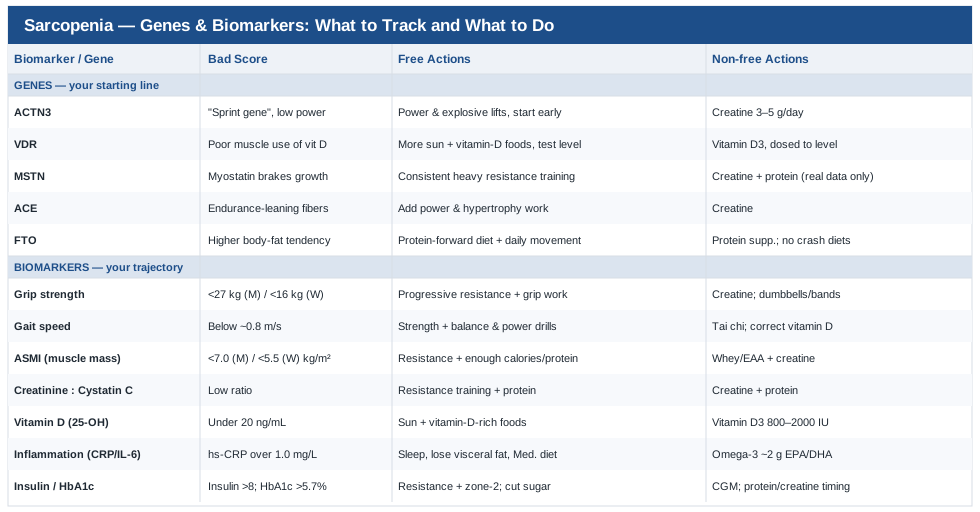
Seven Biomarkers That Reveal Where Your Muscle Really Stands
Muscle loss is sneaky because it happens quietly, over years, and the scale doesn't warn you — you can lose muscle and gain fat while your weight barely moves. Biomarkers cut through that fog. The clinicians who popularized data-driven longevity, like Peter Attia and lipidologists such as Thomas Dayspring and Allan Sniderman, share one core habit: measure, intervene, re-measure. Below are the seven measurements that give you the clearest picture of sarcopenia, ordered from most affordable and validated to more advanced. A large 2025 umbrella review of biomarkers for muscle mass, strength and physical performance (PubMed, 2025) is a useful reminder that no single blood test yet replaces functional testing — which is exactly why the first two markers here are things you do, not things you draw from a vein.
1. Grip Strength — The Cheapest, Most Predictive Number You Own
Grip strength is the single best low-cost proxy for whole-body strength and a powerful predictor of disability and mortality. The revised European consensus (EWGSOP2) puts low muscle strength — measured first by grip — at the center of diagnosing sarcopenia.
How to measure it: A handheld dynamometer costs roughly 20 to 60 USD; many clinics and physios test it free. Squeeze maximally three times per hand, record the best. Warning thresholds commonly used are under about 27 kg for men and 16 kg for women.
If the score is bad, the plan without supplements: Progressive resistance training is the non-negotiable foundation, 2 to 3 sessions per week on non-consecutive days, targeting all major muscle groups with loads heavy enough that the last 2 reps are genuinely hard. Add direct grip work (dead hangs, farmer carries) twice weekly. Prioritize protein at meals, about 1.2 to 1.6 g/kg body weight daily. Frequency/cycling: train year-round; every 8 to 12 weeks, change exercises or add load to avoid plateau. Side effects: minimal beyond normal soreness; deload one week every 2 to 3 months if joints complain.
If the score is bad, the plan with supplements or equipment: Creatine monohydrate, 3 to 5 g daily, has the strongest evidence of any supplement for building strength and lean mass in older adults when paired with training (PMC meta-analysis). No loading phase is needed; take it daily, no cycling required. Side effects: mild water retention early on; drink adequate fluids; generally very safe. Equipment that helps: adjustable dumbbells, resistance bands, or a leg-press machine. Whole-body vibration platforms are an option for the frail who can't yet lift (PMC review on sarcopenia).
2. Gait Speed — The Marker of Severe Sarcopenia
Walking speed reflects the integration of muscle, nerves and balance. EWGSOP2 uses slow gait to flag severe sarcopenia, and it predicts falls and hospitalization.
How to measure it: Free. Walk a marked 4-meter course at normal pace, time it. Below roughly 0.8 m/s is a red flag.
If the score is bad, the plan without supplements: Combine strength training with balance and power work — fast (but controlled) sit-to-stands, step-ups, and single-leg stands. Power matters more than raw strength for walking, so move the concentric (lifting) phase quickly. Practice 3 to 4 times weekly. Side effects: fall risk during balance drills — do them near a wall or counter.
If the score is bad, the plan with supplements or equipment: A tai chi program improves gait and balance measurably (covered later). Vitamin D correction (see below) can nudge the timed-up-and-go and mobility in deficient people. Assistive equipment — a resistance-band circuit or a stationary recumbent bike for leg power — bridges the gap while strength builds.
3. Appendicular Skeletal Muscle Mass Index (ASMI)
This tells you how much muscle you actually have in your arms and legs, normalized to height. It confirms sarcopenia after strength testing flags it.
How to measure it: A DEXA scan (about 50 to 150 USD) is the reference standard; a bioelectrical impedance (BIA) scale (40 to 100 USD for a decent home unit) is a cheaper, less precise alternative you can trend over time. Low cut-offs are around 7.0 kg/m² for men and 5.5 kg/m² for women by DEXA.
If the score is bad, the plan without supplements: Build muscle with progressive resistance training and eat enough total calories — you cannot grow muscle in a large deficit. Distribute protein across meals (25 to 40 g each) to maximize the muscle-building signal, which weakens with age (the "anabolic resistance" problem).
If the score is bad, the plan with supplements or equipment: A leucine-rich whey or essential-amino-acid supplement after training helps overcome anabolic resistance; combined protein-plus-resistance programs outperform either alone (PMC meta-analysis). Creatine again applies here. Frequency: protein daily; side effects: check kidney function first if you have existing kidney disease before high-protein regimens.
4. Serum Creatinine-to-Cystatin C Ratio (The "Sarcopenia Index")
This clever ratio uses two routine blood tests. Creatinine reflects muscle mass; cystatin C reflects kidney filtration independent of muscle. Divide one by the other and you get a low-cost blood signal of muscle bulk. It correlates with muscle area, muscle index and grip strength (SONIC study, PMC) and predicts who later develops sarcopenia (CHARLS cohort, PMC).
How to measure it: Creatinine (10 to 30 USD) plus cystatin C (20 to 50 USD); your lab or you compute the ratio. It's a strong signal in younger-old adults but weakens in the very old.
If the score is bad, the plan without supplements: The same resistance-training and protein foundation — this ratio moves as real muscle changes. Track it every 6 months.
If the score is bad, the plan with supplements or equipment: Creatine and adequate protein, as above. Note one caveat: creatine supplementation can slightly raise serum creatinine without harming kidneys, which can distort this ratio — measure before starting creatine, or interpret with that in mind.
5. Vitamin D (25-Hydroxyvitamin D)
Vitamin D receptors sit on muscle fibers, and deficiency is linked to weakness and falls. The evidence for supplementing is genuinely mixed — some meta-analyses show only small mobility gains (PMC systematic review), and vitamin D monotherapy alone is not a muscle-builder (PubMed, 2022) — but correcting a true deficiency is cheap, safe and worthwhile.
How to measure it: A blood test, 30 to 70 USD. Aim for a level in the sufficient range (commonly 30 to 50 ng/mL); deficiency is under 20 ng/mL.
If the score is bad, the plan without supplements: Sensible sun exposure and vitamin-D-rich foods (fatty fish, eggs, fortified dairy). This alone rarely corrects a real deficiency in older skin.
If the score is bad, the plan with supplements or equipment: Vitamin D3, typically 800 to 2000 IU daily, titrated to your blood level; take with a fatty meal for absorption and pair with adequate calcium and vitamin K2 if advised. Cycling: retest at 3 months, then adjust. Side effects: avoid megadoses — very high intermittent doses have paradoxically increased falls in some trials. More is not better.
6. Inflammation Markers (hs-CRP and IL-6)
Chronic low-grade inflammation — "inflammaging" — actively degrades muscle. Elevated interleukin-6 is consistently linked to lower muscle mass in older adults (PMC meta-analysis). High-sensitivity CRP is the affordable everyday proxy.
How to measure it: hs-CRP is cheap (10 to 40 USD); IL-6 is more specialized (30 to 80 USD). You want hs-CRP well under 1.0 mg/L.
If the score is bad, the plan without supplements: Attack the sources — improve sleep, lose excess visceral fat, quit smoking, treat gum disease, and exercise (which lowers baseline inflammation over time). A Mediterranean-style diet rich in vegetables, olive oil and fatty fish reliably lowers CRP.
If the score is bad, the plan with supplements or equipment: Omega-3 fish oil (about 2 g combined EPA/DHA daily) lowers inflammatory markers and may support the muscle-building response. Cycling: continuous use is fine; side effects: mild blood-thinning — tell your doctor if you take anticoagulants. Curcumin is a lower-evidence option. Persistently high CRP with no obvious cause deserves a medical work-up, not just supplements.
7. Metabolic Markers — Fasting Insulin and HbA1c
Muscle is your largest site of glucose disposal, and insulin resistance both drives and is driven by muscle loss. Rising HbA1c and fasting insulin quietly predict a worse muscle trajectory, which is why Attia-style protocols track them closely.
How to measure it: Fasting insulin (20 to 50 USD) and HbA1c (20 to 50 USD). Favorable ranges are roughly a fasting insulin under 8 µIU/mL and HbA1c under 5.7%.
If the score is bad, the plan without supplements: Resistance training plus zone-2 cardio is the most powerful insulin sensitizer there is. Reduce refined carbohydrates and added sugar, and walk for 10 to 15 minutes after meals to blunt glucose spikes.
If the score is bad, the plan with supplements or equipment: A continuous glucose monitor (CGM) is excellent equipment for learning which foods spike you. Some clinicians use creatine and protein timing to improve glucose uptake. Any pharmacological option (metformin, and increasingly discussed GLP-1 agonists — with careful attention to preserving muscle) is strictly a physician decision.
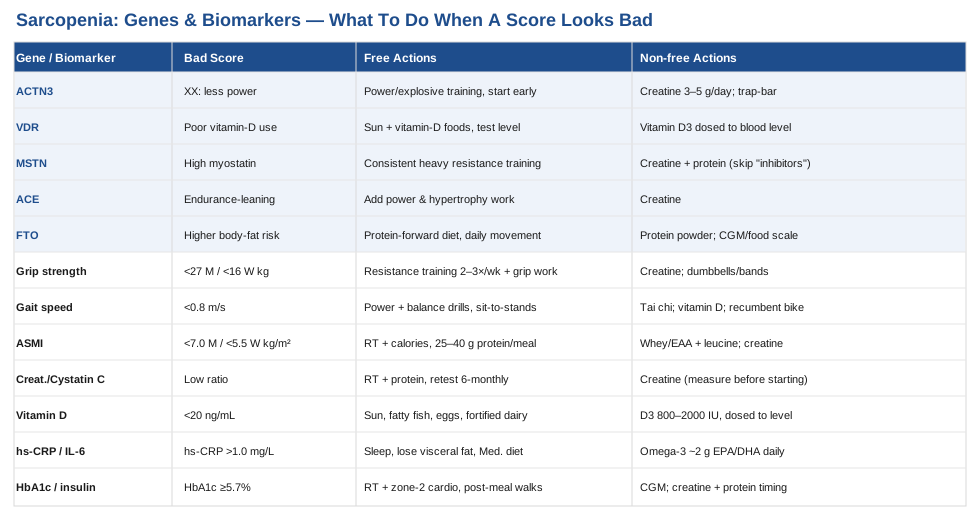
Knowing your numbers is powerful, but numbers don't exist in a vacuum — some of them are partly written into your DNA. That's where the genetic picture fills in the "why."
Five Genes That Shape Your Muscle Destiny
Genetics doesn't decide your fate here; it sets your starting line and tells you where to push harder. Researchers like Ali Torkamani have argued that genomic information is most useful when it changes what you actually do. For muscle, a handful of variants matter more than the rest. Importantly, none of these is "destiny" — every one can be compensated for with the right training, nutrition and monitoring.
ACTN3 — The "Sprint Gene"
The ACTN3 R577X variant determines whether you produce alpha-actinin-3, a protein in fast-twitch (power) muscle fibers. More than a billion people carry the XX version and make none of it, which is linked to reduced power and a faster decline in muscle function with age, plus higher sarcopenia risk in older women (PubMed) and effects on strength and quality of life in the elderly (PMC).
If the gene is bad, the plan without supplements: Emphasize power and explosive-style training — you may respond less to pure sprint stimulus but you can still build strength. Prioritize heavier resistance work and jump/step power drills, and start earlier and more consistently than the average person. Frequency: 3 sessions weekly with dedicated power movements.
If the gene is bad, the plan with supplements or equipment: Creatine monohydrate (3 to 5 g daily) is especially valuable, since it directly fuels the fast, explosive efforts your fibers find harder. A leg-press or trap-bar for safe heavy loading helps. No cycling needed; side effects minimal.
VDR — The Vitamin D Receptor
Variants in the VDR gene affect how well muscle cells use vitamin D and have been associated with muscle strength differences. Evidence is mixed and mostly observational, so treat this as a nudge, not a verdict.
If the gene is bad, the plan without supplements: Be more diligent about sun exposure and vitamin-D-rich foods, and test your blood level rather than assuming.
If the gene is bad, the plan with supplements or equipment: Maintain vitamin D firmly in the sufficient range (D3, dose to level, with a fatty meal), and pair it with resistance training, since the two work together. Retest every 3 to 6 months; avoid megadosing.
MSTN — Myostatin, the Muscle "Brake"
MSTN codes for myostatin (GDF-8), which actively limits muscle growth. Higher myostatin signaling is implicated in age-related muscle loss (PMC review), though as a blood test its value is genuinely uncertain (PMC).
If the gene is bad, the plan without supplements: Resistance training itself naturally lowers myostatin activity, so this is the most direct lever you have. Consistent heavy training over months matters more than any single session.
If the gene is bad, the plan with supplements or equipment: Be skeptical of products marketed as "myostatin inhibitors" (like epicatechin or follistatin supplements) — human evidence is thin. Stick with creatine and protein, which have real data. True myostatin-blocking drugs remain experimental.
ACE — The Endurance/Power Switch
The ACE insertion/deletion polymorphism influences whether you lean toward endurance (I allele) or power (D allele). It's a modest effect, but it can guide how you spend your training energy.
If the gene is bad (for power) without supplements: If you carry the endurance-leaning variant, deliberately add power and hypertrophy training you might otherwise skip, so you don't neglect fast-twitch fibers as they fade fastest with age.
With supplements or equipment: Creatine again supports the power side. Otherwise, no ACE-specific supplement is warranted — training allocation is the real intervention.
FTO — The Body-Composition Gene
FTO variants raise the tendency toward higher body fat, which matters because "sarcopenic obesity" — low muscle plus high fat — is especially damaging.
If the gene is bad, the plan without supplements: Focus on protein-forward eating, appetite awareness, and combining resistance training with daily movement to protect muscle while managing fat. Sleep and stress control blunt FTO's effect on appetite.
If the gene is bad, the plan with supplements or equipment: A protein supplement improves satiety and preserves muscle during any fat-loss phase; a food scale or CGM helps you stay honest. Never crash-diet — aggressive deficits burn muscle you're trying to save.
Genes and biomarkers describe the machinery. The next section is about the mindset that ties them together — and it comes from a book that has quietly changed how a growing number of clinicians talk about aging.
The Muscle-Centric View: 10 Ideas From "Forever Strong"
Dr. Gabrielle Lyon's book Forever Strong popularized "muscle-centric medicine," the argument that we've been treating aging backwards — obsessing over fat when the real driver of healthspan is how much strong, metabolically active muscle we carry. It leans heavily on published research and challenges the still-common clinical habit of ignoring muscle until someone is already frail. Here are ten of its most useful ideas.
1. Muscle Is an Organ, Not Just Tissue
Skeletal muscle is your body's largest endocrine and metabolic organ. It stores glucose, releases beneficial signaling molecules (myokines), and buffers you against disease. Losing it isn't cosmetic — it's a systemic failure.2. You're Not Over-Fat; You're Under-Muscled
The reframe at the book's core: many metabolic problems blamed on excess fat are really the downstream effect of too little muscle. Building muscle can fix what dieting alone cannot.3. Muscle Is the Organ of Longevity
Strength and muscle mass predict how long and how well you live, often better than many standard risk factors. Investing in muscle in midlife pays compounding dividends later.4. Protein Is the Priority Macronutrient
Lyon argues most people, especially older adults, eat too little protein. She advocates roughly 1 g per pound of ideal body weight for many active adults — higher than official minimums, aligned with the PROT-AGE expert recommendations.5. The First Meal Sets the Tone
A protein-rich breakfast (around 30 to 50 g) triggers muscle protein synthesis early and reduces overeating later. Skipping protein at breakfast wastes an anabolic window.6. Leucine Is the Trigger
The amino acid leucine flips the muscle-building switch. Older muscle needs a higher leucine threshold to respond — a key reason "anabolic resistance" develops and why protein quality, not just quantity, matters.7. Resistance Training Is Medicine
Lifting is non-negotiable. Resistance training is framed not as optional fitness but as prescription-grade medicine for metabolic health, bone density and independence.8. Aerobic Work Still Matters
Muscle-centric doesn't mean cardio-negative. Zone-2 aerobic training builds the mitochondria that keep muscle metabolically healthy and improve insulin sensitivity.9. Mindset and Discipline Over Motivation
The book spends real time on the psychology of showing up — building identity-based habits rather than relying on fleeting motivation, because muscle is won over years.10. Start Now, Whatever Your Age
Muscle remains adaptable into your 80s and 90s. It's never too late to begin, and the cost of waiting is measured in independence lost.The through-line of the book — that muscle is trainable at any age — is exactly what makes the gentler, complementary approaches below worth considering, especially for anyone not yet ready for a heavy barbell.
Complementary Approaches Worth Considering
These are supports, not substitutes, for resistance training and protein. They earn a place here because each has real human trials for strength, balance or function in older adults — and where the evidence is thin, that's stated plainly.
Tai Chi
Tai chi is a slow, weight-shifting movement practice that trains balance, coordination and lower-body control — precisely the functions that decline in sarcopenia and drive falls. Because it's low-impact and social, adherence tends to be excellent among older adults.
A meta-analysis of randomized trials found tai chi significantly improves lower-body strength in older people (PMC), and a separate systematic review confirms meaningful gains in balance and fall prevention (PMC). A typical protocol is a Yang-style program, 2 to 3 sessions weekly of 45 to 60 minutes, for at least 12 weeks.
To apply it realistically: join a beginner class or follow a structured video, focus on deep, stable stances (that's where the leg strength comes from), and use it as the balance-and-mobility layer on top of your resistance training — not a replacement for it.
Yoga
Yoga combines isometric holds, bodyweight loading and balance challenges, which can build lower-limb strength and flexibility in people who aren't ready for weights. It also improves sleep and mood, both of which indirectly support muscle recovery.
A meta-analysis of randomized trials reported significant improvements in balance, flexibility and muscle strength in older adults practicing yoga (PMC). Chair yoga and prop-assisted (Iyengar) styles make it accessible even for the frail. A reasonable dose is 2 to 3 sessions weekly.
To apply it cautiously: choose a class oriented to older adults or beginners, use props and a wall for balance poses, and avoid extreme positions if you have osteoporosis or joint replacements. Treat yoga as a strength-and-balance adjunct, not your only muscle stimulus.
Qigong
Qigong is a gentle Chinese practice of coordinated posture, movement and breathing, closely related to tai chi. It's appealing for very deconditioned or older individuals because the intensity is low and the fall risk minimal.
The direct evidence specifically for sarcopenia is more limited than for tai chi, and many studies group the two together, so its muscle-building effect is best described as promising but not yet firmly established. Where it clearly helps is balance, mobility and adherence — a gateway to more demanding exercise.
To apply it sensibly: use qigong as an on-ramp if you find tai chi or yoga too complex, aim for near-daily short sessions, and progress toward resistance training as your confidence and stability improve.
Photobiomodulation (Low-Level Laser Therapy)
Photobiomodulation uses specific wavelengths of red or near-infrared light to support muscle energy production and reduce fatigue, and it's been studied as an add-on to resistance training in older adults.
A systematic scoping review found it may enhance muscle metrics and performance when combined with resistance exercise, though it does not consistently beat exercise alone (PMC). The evidence is genuinely mixed, and protocols (wavelength, dose, timing) vary widely.
To apply it realistically: view it as an experimental adjunct, not a core strategy. If you try a device, apply it before training on the target muscles per the manufacturer's guidance, keep your expectations modest, and never let it displace the lifting and protein that do the real work.
Conclusion
Sarcopenia rewards specificity. The people who hold onto their strength into old age are rarely the ones who did more of everything — they're the ones who found their weak links and pushed there. Your biomarkers reveal those weak links (a soft grip, a slow walk, a low vitamin D, a creeping HbA1c), and your genes explain why some links were always going to fray first. Neither is a sentence; both are a map.
The plan itself is refreshingly consistent no matter which number is off: resistance training you actually keep doing, enough high-quality protein, creatine and vitamin D where indicated, inflammation kept low, and gentler practices like tai chi to protect balance along the way. Muscle stays adaptable for your entire life — that is the grounded hope running through everything above.
The smart next step is small and concrete. Test your grip strength and your walking speed this week, ask your doctor for a basic panel (vitamin D, hs-CRP, HbA1c, and the creatinine-to-cystatin-C ratio), and re-check in three to six months so you can see the trend, not just a snapshot. Then bring those numbers to a qualified professional and build the specific plan they point to. Better information, acted on early, is how muscle loss gets reversed — one measured, deliberate decision at a time.
This article is for general education and is not medical advice. Talk with a qualified healthcare professional before starting supplements, new training, or changing treatment — especially if you have kidney disease, take anticoagulants, or manage a chronic condition.
Musculoskeletal Endocrine & Metabolic
Musculoskeletal: Muscle Conditions