This article contains AI generated content.
Subacute Combined Degeneration Of The Spinal Cord: Genes And Biomarkers — 6 Genes And 7 Biomarkers To Track
Introduction
If you have landed here, you are probably not looking for a dictionary definition. You may be dealing with numb feet that feel like they are wrapped in cotton, a strange loss of balance in the dark, tingling that climbs up the legs, or a lab result that finally gave a name to months of vague symptoms. Subacute combined degeneration of the spinal cord is a real, mechanical problem: the protective myelin around the dorsal columns and lateral tracts of the cord breaks down, usually because the body has run short of the raw materials it needs to keep that insulation intact.
Most general advice stops at three words: take vitamin B12. That is not wrong, but it is nowhere near the full picture. It skips over why the deficiency happened in the first place, why some people have normal-looking B12 on paper yet still have a struggling nervous system, why copper deficiency can produce an almost identical picture, and why timing matters so much that a few months can be the difference between full recovery and permanent change.
This article takes a more precise approach. Instead of a single generic instruction, it treats your body like a system you can actually read. The most useful thing about this condition is that it is one of the few myelopathies that is often partly or fully reversible when the underlying signal is caught early — and the signals are measurable.
That is the grounded hope here: better information leads to better decisions. Below, you will find the biomarkers worth tracking (the primary focus, because they map directly onto what is going wrong), a shorter look at the genes that can quietly tilt the odds, a book that has changed how many people think about B12, and a careful review of supportive practices for the symptoms that linger. None of these replace a clinician — but together they help you ask sharper questions and notice change faster.
Summary
Subacute combined degeneration is, at its core, a supply-chain failure in the nervous system — and supply chains can be measured. This article opens with the seven biomarkers that reveal whether your myelin is getting what it needs: not just serum B12, but the smarter functional markers that catch trouble when a standard B12 test looks deceptively "normal." You will learn which single blood test is considered the most sensitive early warning sign, why homocysteine and folate must be read together, and why one overlooked mineral can mimic B12 deficiency almost perfectly and derail a diagnosis for months.
For each marker, you will find how to measure it, a realistic cost range, and a two-track plan to improve it — one that uses food and habits alone, and one that adds targeted supplements or medical equipment, always with frequency, cycling, and side effects spelled out. After that, a compact section covers six genes that can quietly raise your risk even with a decent diet, and how each can be worked around.
Then comes a book summary that challenges the standard medical shrug toward B12, and a grounded look at movement and mind-body practices that can help the balance and sensation problems that outlast the deficiency itself. Read on to see the exact numbers worth knowing — and what to do when they come back wrong.
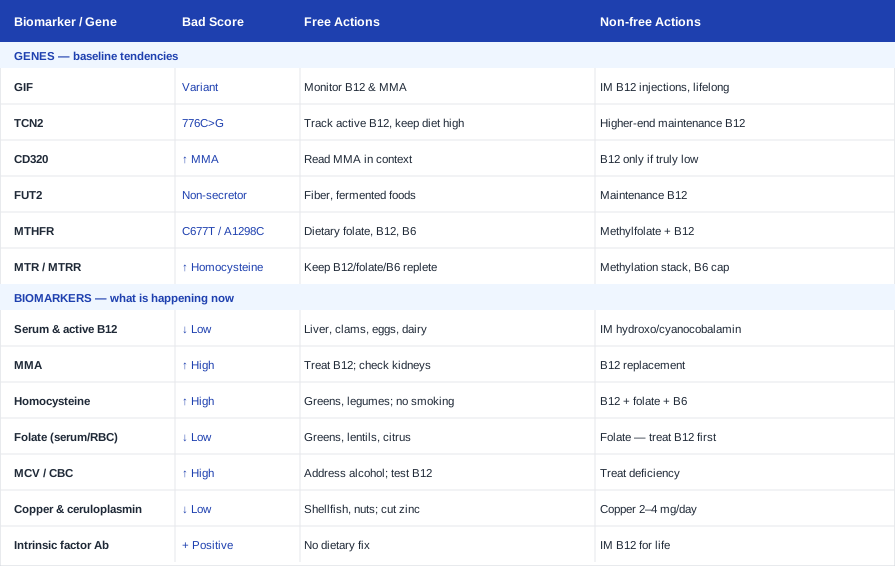
The Biomarkers Worth Tracking
Subacute combined degeneration is a diagnosis where the labs genuinely tell the story. The condition is driven by a breakdown in the methylation cycle — the chemistry that keeps myelin repaired — and every step of that cycle leaves a measurable trace. Clinicians like Peter Attia, Thomas Dayspring, and Allan Sniderman have popularized a simple principle that applies perfectly here: don't measure the storage tank, measure whether the fuel is actually reaching the engine. For B12, the "tank" (serum B12) is famously unreliable, which is why the functional markers below matter so much.
A quick and important caveat before the list: this condition can worsen quickly and some damage becomes permanent. Tracking biomarkers is for understanding and monitoring, not for replacing urgent treatment. If you have active neurological symptoms, the biomarkers should be interpreted with a clinician, and treatment (often B12 injections) should not wait. According to the StatPearls reference on the condition (NCBI Bookshelf, Spinal Cord Subacute Combined Degeneration), early replacement is what preserves function.
1. Vitamin B12 — total serum and active (holotranscobalamin)
Why it matters: B12 is the cofactor your body needs to keep myelin maintained. But total serum B12 counts all the B12 in your blood, most of which is bound to a protein your cells cannot use. Holotranscobalamin (active B12) measures only the fraction that cells can actually take up — the fuel reaching the engine. A "normal" total B12 with a low active B12 is a classic trap.
How to measure it: A standard serum B12 test is inexpensive and included in most panels (often about $20–50, or bundled). Active B12 (holotranscobalamin) is a specialized add-on, usually $40–90. A large diagnostic-accuracy study found active B12 among the earliest markers to move (diagnostic accuracy of holotranscobalamin, B12, MMA and homocysteine).
If the score is bad, the plan without supplements: Emphasize dense dietary sources — clams, beef liver, sardines, salmon, eggs, and dairy. If you eat little animal food, this alone will rarely be enough, which is honest to say. Address alcohol intake, which impairs absorption, and review any acid-reducing medication with your doctor, since stomach acid is required to release B12 from food.
If the score is bad, the plan with supplements or equipment: For a true deficiency causing neurological symptoms, oral supplements are usually not sufficient at first. The standard is intramuscular hydroxocobalamin or cyanocobalamin injections (commonly 1 mg on a loading schedule of several doses over two weeks, then maintenance every 1–3 months). Maintenance oral or sublingual doses (1,000 mcg daily) can follow. Frequency and cycling should be set by a clinician and guided by follow-up labs. Side effects are rare but can include injection-site soreness and, occasionally, a drop in potassium as blood cells regenerate — a reason for early monitoring.
2. Methylmalonic acid (MMA)
Why it matters: This is arguably the single most valuable number on this page. When cellular B12 runs short, methylmalonic acid backs up because B12 is required to clear it. MMA is widely regarded as the most sensitive and specific functional marker of B12 deficiency, catching a problem before serum B12 drops. It rises in B12 deficiency but not in folate deficiency, which helps separate the two.
How to measure it: A serum or urine MMA test, typically $60–150. Urinary MMA (reported against creatinine) has been studied as an early indicator in neuropathy (urinary MMA and polyneuropathy). One caveat: reduced kidney function can raise MMA independently, so it is read alongside renal markers (MMA and B12 status monitoring).
If the score is bad, the plan without supplements: There is no food that lowers MMA except the B12 it is signaling for. The practical move is to treat the B12 gap and confirm normal kidney function. Reducing alcohol and improving overall protein status support the cycle indirectly.
If the score is bad, the plan with supplements or equipment: The corrective is B12 replacement (see marker 1). Elevated MMA that falls after B12 injections is close to confirmation of the diagnosis. Recheck MMA roughly 4–8 weeks after starting treatment to verify the trend is heading down. No cycling is needed beyond the maintenance B12 schedule; the marker itself has no side effects.
3. Homocysteine
Why it matters: Homocysteine sits at a crossroads that needs B12, folate, and B6 to be cleared. It rises in both B12 and folate deficiency, so it is sensitive but not specific — which is exactly why it is read together with MMA. High homocysteine with high MMA points to B12; high homocysteine with normal MMA points more toward folate.
How to measure it: A fasting serum homocysteine test, roughly $30–80. It should be drawn fasting, since a recent high-protein meal can nudge it up.
If the score is bad, the plan without supplements: Increase leafy greens, legumes, and B6-rich foods, moderate alcohol, and improve sleep and physical activity, all of which modestly support methylation. If you smoke, this is one more reason to stop, as it raises homocysteine.
If the score is bad, the plan with supplements or equipment: A combination of B12, folate (or methylfolate), and B6 reliably lowers homocysteine. A typical stack is methylcobalamin plus 400–800 mcg methylfolate plus P5P (B6). Keep B6 under about 50–100 mg daily long term, because chronic high-dose B6 can itself cause a reversible sensory neuropathy — an important side effect for someone already worried about nerve health. Re-test after 8–12 weeks; there is no need to cycle, but B6 should not be pushed high indefinitely.
4. Folate (serum and red blood cell)
Why it matters: Folate and B12 are metabolic partners. When B12 is low, folate gets "trapped" in a form the body cannot use — the so-called methyl-folate trap. Critically, giving high-dose folate to someone with untreated B12 deficiency can improve the anemia while the spinal cord damage silently continues. That is why folate is measured with B12, never instead of it.
How to measure it: Serum folate is cheap (often bundled, $15–40). Red blood cell (RBC) folate reflects longer-term status and costs a little more ($40–70).
If the score is bad, the plan without supplements: Leafy greens, lentils, beans, asparagus, and citrus are rich sources. Cooking gently and not overboiling preserves folate. Reduce alcohol, which depletes it.
If the score is bad, the plan with supplements or equipment: Folate supplementation (400–800 mcg, methylfolate if you prefer the active form) corrects a genuine folate deficiency. The non-negotiable rule: confirm B12 is adequate or being treated first. Side effects are minimal at these doses. No cycling is required; re-test in 8–12 weeks.
5. Complete blood count and mean corpuscular volume (MCV)
Why it matters: B12 and folate deficiency classically enlarge red blood cells, raising the MCV (macrocytosis) and eventually causing anemia. It is an inexpensive early flag. The catch — and it is a big one — is that neurological damage can occur before the blood ever looks abnormal, and iron deficiency can mask a high MCV. So a normal CBC does not rule the condition out.
How to measure it: A standard CBC, one of the cheapest tests available (often $10–30 or included in routine panels).
If the score is bad, the plan without supplements: A high MCV is a prompt to investigate cause, not something you fix by diet directly. Address alcohol (a common cause of macrocytosis on its own) and pursue B12/folate testing.
If the score is bad, the plan with supplements or equipment: Treat the underlying deficiency. As new blood cells form rapidly after B12 replacement, potassium can dip, so early follow-up bloodwork is wise. Recheck the CBC at 4–8 weeks to confirm MCV is normalizing.
6. Copper and ceruloplasmin
Why it matters: This is the marker most often forgotten, and it can cost months. Copper deficiency myelopathy produces an almost identical clinical and MRI picture to B12-driven subacute combined degeneration — the same posterior-column signal, the same gait and sensory loss (why the phenotype is so similar). If B12 is normal, copper must be checked before concluding anything. Cases documented in the literature show striking overlap (copper-mimicking case report) and copper deficiency also causes polyneuropathy (copper deficiency and polyneuropathy).
How to measure it: Serum copper and ceruloplasmin together, roughly $50–120. Low ceruloplasmin is often the first clue.
If the score is bad, the plan without supplements: Copper-rich foods include shellfish, organ meats, nuts, seeds, and dark chocolate. Crucially, review zinc intake — excess zinc (from high-dose supplements or denture creams) is a leading cause of copper deficiency and must be reduced. Bariatric surgery and malabsorption are other common causes to explore with your clinician.
If the score is bad, the plan with supplements or equipment: Copper repletion (commonly copper 2–4 mg daily, or higher medically supervised doses initially) restores levels. Stop or reduce any offending zinc source. Copper and zinc compete, so they should be spaced apart if both are needed. Re-test in 4–8 weeks. Side effects of copper supplements are mainly gastrointestinal; excess copper is harmful, so this is dose-controlled and monitored, not open-ended.
7. Intrinsic factor and parietal cell antibodies
Why it matters: This marker answers why the deficiency happened. Pernicious anemia — an autoimmune attack on the stomach cells that make intrinsic factor (the protein B12 needs for absorption) — is a leading cause. Finding these antibodies changes the plan: oral B12 will not fix an absorption failure, so lifelong injections or high-dose protocols become the answer.
How to measure it: Intrinsic factor antibodies and anti-parietal cell antibodies, typically $60–150 together. Gastrin levels are sometimes added.
If the score is bad, the plan without supplements: There is no dietary fix for an absorption defect; this result is about route, not intake. It also flags a need to screen for associated autoimmune conditions (thyroid, for example) and, in some cases, periodic surveillance for stomach changes.
If the score is bad, the plan with supplements or equipment: Positive antibodies usually mean intramuscular B12 replacement for life, or very high-dose oral B12 under supervision (which can work through passive absorption in some people). Frequency is individualized — often monthly maintenance after loading. This is a marker that reframes the whole strategy, which is why it belongs on the list.
The Genes That Quietly Tilt The Odds
Biomarkers show what is happening now; genes hint at your baseline tendencies. Researchers like Ali Torkamani (who works on translating personal genomics into actionable insight) and popularizers like Gary Brecka have pushed the idea that a handful of common variants can make some people far more sensitive to the same nutritional pressures. For this condition, the genetics cluster tightly around B12 handling and the methylation cycle. Think of these as amplifiers of risk — rarely the sole cause, but often the reason two people on similar diets end up in different places.
A grounding note: for most of these variants, the strongest evidence is that they shift levels and requirements, not that they single-handedly cause myelopathy. Where the evidence is early, that is stated plainly.
GIF — gastric intrinsic factor
The GIF gene codes for intrinsic factor itself. Rare loss-of-function variants cause hereditary intrinsic factor deficiency, an inherited inability to absorb B12 that can present in childhood or adulthood. This connects directly to the antibody biomarker above — a person can lack functional intrinsic factor from genetics rather than autoimmunity.
Plan without supplements: Diet cannot overcome absent intrinsic factor, so the emphasis is on early recognition and monitoring B12 status rather than food strategy. Plan with supplements or equipment: Bypass the gut entirely with intramuscular B12 injections, or use high-dose oral B12 that relies on passive absorption. This is lifelong, monitored with periodic B12 and MMA. No cycling; side effects are those of B12 injections (minimal).
TCN2 — transcobalamin 2
TCN2 makes the transport protein that carries B12 into cells (the same protein measured as active B12). Common variants such as the 776C>G change can subtly lower how efficiently B12 is delivered, meaning some people need higher circulating levels to achieve the same cellular delivery. Human evidence links these variants to altered B12 and homocysteine markers, though effect sizes are modest.
Plan without supplements: Keep dietary B12 generous and track active B12 rather than trusting total B12. Plan with supplements or equipment: Aim for the higher end of the normal range with maintenance B12 (oral 1,000 mcg daily, or injections if symptomatic), guided by holotranscobalamin and MMA. Re-test every 3–6 months; no cycling needed.
CD320 — the transcobalamin receptor
CD320 encodes the receptor cells use to pull in the B12-transcobalamin complex. Certain variants raise MMA in newborn screening even when the person is clinically well, which is a useful reminder that a high MMA occasionally reflects genetics rather than true deficiency. The clinical significance in adults is still being clarified — this is an area of early evidence.
Plan without supplements: Interpret an isolated high MMA cautiously and in context. Plan with supplements or equipment: If deficiency is genuine, standard B12 repletion applies; if MMA stays high on adequate B12, this variant is worth discussing rather than escalating doses endlessly. Monitoring, not aggressive supplementation, is the theme here.
FUT2 — secretor status
FUT2 variants (non-secretor status) are among the most consistent genetic influences on serum B12 levels in large human studies, partly by shaping the gut environment and B12-related bacteria. Non-secretors often show different B12 readings, which can make interpretation trickier.
Plan without supplements: Support gut health with fiber and fermented foods, and lean on functional markers (MMA, active B12) rather than serum B12 alone. Plan with supplements or equipment: Maintenance B12 as needed, with the same testing cadence. Because the effect is on measured levels more than on true requirement, over-supplementing based on a single number is the main risk to avoid.
MTHFR — C677T and A1298C
MTHFR is the most talked-about variant on the internet, often over-hyped. The C677T variant reduces the enzyme that produces active folate, which can raise homocysteine, especially when folate is low. It does not directly cause subacute combined degeneration, but it can amplify a methylation strain.
Plan without supplements: Prioritize dietary folate (greens, legumes) and adequate B12 and B6; this alone normalizes homocysteine in many carriers. Plan with supplements or equipment: Methylfolate (400–800 mcg) plus B12 lowers homocysteine reliably. Keep doses modest — mega-dosing methylfolate offers no proven added benefit and can cause irritability or sleep changes in sensitive people. Re-test homocysteine in 8–12 weeks.
MTR and MTRR — methionine synthase and its reductase
MTR and MTRR encode the enzyme (and its recycling partner) that uses B12 to convert homocysteine back to methionine — the exact reaction that keeps myelin methylation running. Variants here can raise homocysteine and increase B12 demand. Evidence is moderate: these are contributors, not sole drivers.
Plan without supplements: Keep B12, folate, and B6 replete through food, and monitor homocysteine. Plan with supplements or equipment: The same methylation stack (B12 + methylfolate + B6), with the same B6 safety ceiling (avoid chronic high-dose B6 to protect the nerves). Re-check homocysteine and MMA a couple of months in; no cycling required beyond steady maintenance.
The Book That May Change How You Think About B12
If one resource captures the spirit of this article, it is Could It Be B12? An Epidemic of Misdiagnoses by nurse Sally Pacholok and physician Jeffrey Stuart. It is directly relevant because subacute combined degeneration is, in many cases, the tragic endpoint of a B12 deficiency that was missed for too long. The book's central argument challenges conventional practice: that B12 deficiency is far more common, far more under-tested, and far more damaging than the medical mainstream assumes. Here are ten of its most impactful takeaways, framed for your situation.
1. "Normal" B12 ranges may be set too low
The authors argue that people in the low-normal range can already be symptomatic, and that the reference range misses many suffering patients. This is why functional markers like MMA matter.2. Neurological damage can precede anemia
A key, repeated message: waiting for a big red blood cell (macrocytosis) before testing B12 lets nerve damage progress silently. Normal blood does not mean normal nerves.3. Symptoms masquerade as other diseases
The book documents B12 deficiency mimicking multiple sclerosis, early dementia, Parkinson's, and diabetic neuropathy — a warning to keep B12 on the list when a diagnosis does not quite fit.4. Test functionally, not just with serum B12
It champions methylmalonic acid and homocysteine as the tests that catch what serum B12 misses — the same logic that anchors the biomarker section above.5. Folic acid can hide the problem
High folate intake (including from fortified food) can correct the anemia while neurological damage continues. The book treats this as a systemic blind spot.6. Certain groups are high-risk
Older adults, vegans and vegetarians, people on metformin or acid-reducers, and those with gut surgery or autoimmune conditions are flagged for regular testing.7. Metformin and acid blockers deplete B12
Common, long-term medications quietly reduce absorption — a reason to test proactively rather than reactively if you take them.8. Early treatment is dramatically more effective
The book hammers the reversibility window: caught early, recovery can be near-complete; caught late, deficits can be permanent. Urgency is the theme.9. Injections are often necessary
Where absorption is the problem (pernicious anemia, gut disease), oral pills are not enough, and the authors advocate injections without hesitation.10. Patients often have to advocate for themselves
Perhaps the most empowering message: knowing the right tests to request, and asking for them, has changed outcomes for many readers. Use it as informed context, not as a substitute for a clinician — but do bring the questions.Supportive Practices For The Symptoms That Linger
Even after the root cause is treated, balance problems, unsteady walking, and residual numbness can persist while the nervous system slowly repairs. The practices below do not treat the deficiency — only nutrients and medical care do that — but several have meaningful human evidence for the symptoms that overlap with this condition, particularly balance and neuropathic discomfort. Where the evidence comes from related conditions rather than subacute combined degeneration specifically, that is stated honestly.
Tai chi for balance and gait
Tai chi is a slow, weight-shifting movement practice that trains balance, proprioception, and lower-limb control — exactly the systems damaged when the dorsal columns are affected. Because loss of position sense and unsteady walking are core features here, a practice that retrains balance is directly relevant.
The best supporting evidence comes from peripheral neuropathy research: a mixed-methods study found tai chi improved single-leg stance, walking distance, and gait speed in people with clinical neuropathy (impact of tai chi on peripheral neuropathy). This is neuropathy evidence, not myelopathy evidence, so treat it as promising rather than proven for this exact diagnosis.
Practically, start with a beginner class or supervised program, ideally near a wall or sturdy support given fall risk, two to three sessions a week. Progress slowly, and clear it with your care team first if your balance is significantly impaired — the goal is safe retraining, not testing your limits.
Yoga for stability and body awareness
Gentle, adapted yoga builds strength, flexibility, and body awareness, which can help someone relearn stable movement after proprioceptive loss. Its relevance here is in supporting posture, confidence, and reducing the deconditioning that follows months of unsteady walking.
Direct trials in subacute combined degeneration do not exist, so the evidence is indirect — drawn from balance and quality-of-life improvements in other neurological and older-adult populations. It is fair to call this supportive and low-risk rather than condition-proven.
Choose a slow, chair-assisted or restorative style rather than fast flows, work with an instructor aware of your balance limitations, and avoid poses requiring closed-eye standing balance until your stability improves. Two or three short sessions weekly is a reasonable, sustainable starting point.
Photobiomodulation (low-level laser therapy)
Photobiomodulation uses specific wavelengths of low-level light aimed at supporting cellular energy and easing nerve-related discomfort. Its potential relevance is for the burning, tingling, and numbness that can outlast the deficiency, targeting the peripheral component of symptoms.
The human evidence in peripheral neuropathy is mixed: some trials report reduced pain and improved sensation, others show little effect, and there is no strong evidence it repairs spinal cord myelin. So it is best framed as a possible symptom-comfort tool, not a treatment for the underlying degeneration.
If you try it, use it as an adjunct alongside proven nutritional treatment, seek a practitioner or device with documented parameters, and set realistic expectations. Stop if it does not help after a reasonable trial, and never let it delay or replace B12 or copper correction.
Mindfulness meditation and relaxation training
Mindfulness and structured relaxation do not repair nerves, but they have solid human evidence for helping people cope with chronic sensory symptoms, sleep disruption, and the anxiety that a frightening neurological diagnosis brings. For a condition where uncertainty is part of the experience, that is genuinely useful.
Randomized trials across chronic pain and neuropathic conditions show mindfulness-based approaches can reduce distress and improve quality of life, even when the physical symptom is unchanged. The evidence is for coping and well-being, which is exactly the claim being made here — no more.
A simple starting protocol is ten to twenty minutes daily of guided breathing or body-scan meditation, using a free app or recording. It pairs well with the movement practices above and carries essentially no risk, making it an easy addition while the slower work of nerve recovery continues.
Conclusion
Subacute combined degeneration of the spinal cord is one of the more hopeful diagnoses in neurology precisely because it is measurable and, when caught early, often reversible. The through-line of this article is simple: don't trust a single reassuring number. Read the functional markers — methylmalonic acid, homocysteine, active B12 — alongside folate, the blood count, and the copper panel, and ask why a deficiency happened by checking for intrinsic factor antibodies. The genes can tilt your baseline, but the biomarkers tell you what is happening today, and the treatment window is what matters most.
The most important idea to carry away is urgency paired with precision: nerve damage can advance while blood tests still look normal, so getting the right tests early is the single highest-value move you can make.
If this resonates, take one concrete next step this week. Write down your symptoms and when they started, gather any recent B12, MMA, or blood-count results, and book a conversation with a qualified clinician — bringing the specific markers named here so the discussion is sharp rather than vague. Better information really does lead to better decisions, and in this condition, timely decisions can protect the function you still have and help recover what you can.