This article contains AI generated content.
Popliteus Tendinopathy: 4 Genes and 7 Biomarkers to Track
Introduction
If you have been dealing with a nagging ache behind the outer or back part of your knee, especially after downhill running, deep squats, or sudden pivoting, you have probably already heard the standard advice: rest it, ice it, stretch the hamstrings, maybe try some eccentric loading. Some of that helps. A lot of it doesn't stick, because popliteus tendinopathy is not a common injury, and most generic tendon advice is written with the Achilles or the patellar tendon in mind, not the small, oblique, rotation-controlling tendon tucked into the back of your knee.
The frustrating part is that two people with what looks like the same diagnosis can respond completely differently to the same rehab protocol. One recovers in six weeks. Another does the exact same exercises for six months and barely moves the needle. That gap is rarely explained by effort or technique alone. It is often explained, at least in part, by what is happening underneath the surface: how your body builds and repairs collagen, how much inflammation and metabolic stress your tendons are dealing with day to day, and which version of certain tendon-related genes you happen to carry.
This article takes that underneath-the-surface view seriously, without overselling it. There is no single blood test or gene panel that will hand you a guaranteed fix. But there is a growing, genuinely useful body of research connecting tendon health to measurable biomarkers, and a smaller but real body of research connecting tendon injury risk to specific genetic variants. Used together, they give you something more actionable than "rest and stretch": a way to check whether your internal environment is working for your tendon or against it, and specific, practical steps to shift it in your favor.
The goal here is not certainty, it's better odds. We'll walk through the biomarkers worth tracking first, since they are the most practical and modifiable starting point, then look at what current genetics research suggests, then bring in what a well-known tendon-science podcast has to say about recovery, and finish with complementary approaches that have actual clinical evidence behind them for tendon problems. Taken together, these give you a clearer, more grounded path than "give it time and see."
Summary
Popliteus tendinopathy rarely gets the deep-dive treatment that Achilles or patellar tendinopathy get, but the underlying biology is shared: tendons are living tissue, and how well yours holds up depends heavily on things you can actually measure. Below, you'll find seven biomarkers, spanning lipids, blood sugar, inflammation, vitamin D, thyroid function, and uric acid, that shape how your tendons build and maintain collagen, and a clear plan for improving each one, with and without supplements. You'll also find what four tendon-related genes (COL5A1, GDF5, MMP3, and TNC) may mean for your personal injury risk, what a leading tendon-science podcast reveals about practical recovery protocols most people never hear about, and which complementary therapies actually hold up under clinical scrutiny for tendon problems. If you have been guessing your way through this injury, the next sections give you something more concrete to work from.
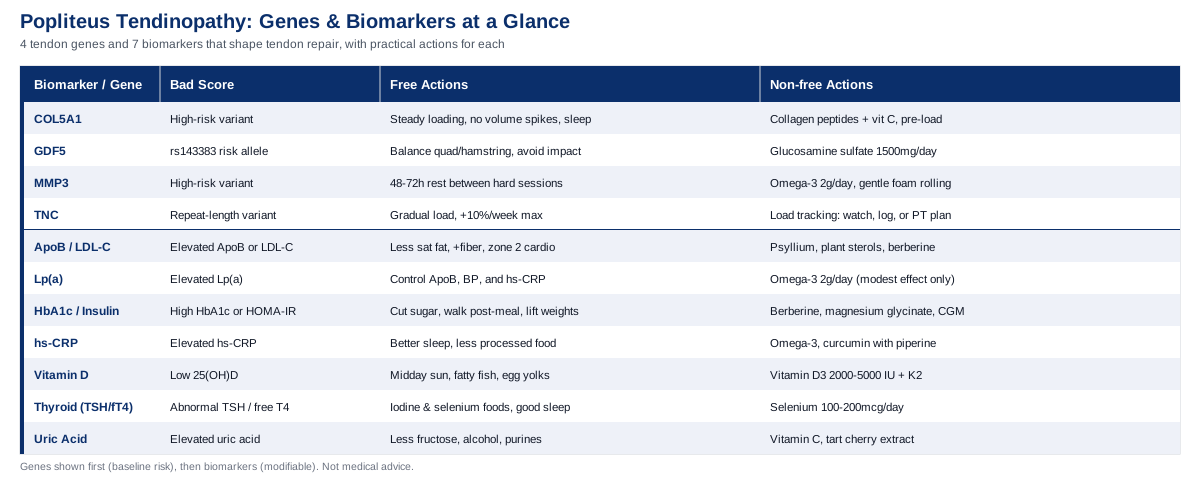
7 Biomarkers Worth Tracking for Popliteus Tendinopathy
Tendon tissue is metabolically active. It is constantly breaking down and rebuilding collagen, and that process is sensitive to your blood chemistry in ways most people never think to check. This is the approach favored by researchers like Peter Attia, Thomas Dayspring, and Allan Sniderman, who have spent years arguing that the standard basic panel misses a lot of what actually predicts tissue and vascular health. Below are the seven markers most worth tracking if you're dealing with popliteus tendinopathy, roughly ordered from most foundational to most situational.
Apolipoprotein B (ApoB) and LDL Cholesterol
Elevated cholesterol-carrying particles do more than affect your arteries. In people with familial hypercholesterolemia, cholesterol deposits build up directly inside tendon tissue, most visibly in the Achilles tendon, and this has been documented as a common and often unrecognized clinical sign, showing up as tendon pain and thickening far more often in affected patients than in controls, as described in this study on familial hypercholesterolemia and Achilles tenosynovitis. The same lipid burden that stresses your vasculature appears to stress lower-limb tendons, including ones like the popliteus that sit under repeated rotational load. Dayspring and Sniderman have both argued for years that ApoB, which counts the actual number of atherogenic particles, is a more accurate readout than LDL cholesterol alone, which only estimates the cholesterol content of those particles.
How to measure it
A standard lipid panel with LDL-C is inexpensive and often covered by insurance, typically ten to thirty dollars out of pocket if not covered. A direct ApoB assay costs roughly thirty to eighty dollars and is not always covered, so ask specifically for it by name. An advanced NMR lipid panel that also reports particle number (LDL-P) runs closer to one hundred to two hundred dollars and is the most detailed option, though not necessary for most people just starting out.If the score is bad, the plan without supplements
Shift saturated fat intake down and soluble fiber intake up, aiming for ten to fifteen grams of soluble fiber daily from oats, legumes, and vegetables. Add three to five hours per week of zone 2 aerobic exercise, which reliably improves lipid particle profiles over eight to twelve weeks. If body composition is a factor, even a modest five to ten percent reduction in body fat tends to move ApoB meaningfully.If the score is bad, the plan with supplements or equipment
Psyllium husk, five grams once or twice daily with water, is well tolerated and modestly lowers LDL-C. Plant sterols or stanols at two grams daily, taken with meals, have a similar effect. Berberine at five hundred milligrams two to three times daily can help, but should be cycled eight to twelve weeks on and four weeks off, since long-term continuous use data is limited, and it can cause gastrointestinal upset, especially early on. None of these replace a statin if your ApoB is significantly elevated and your physician recommends one; supplements here are for modest, borderline cases, not a substitute for medical management.Lipoprotein(a)
Lp(a) is largely genetically determined and stays fairly stable throughout adult life, which is why Attia recommends testing it once, rather than repeatedly. It matters here because elevated Lp(a) is associated with a more inflammatory, pro-thrombotic internal environment, and connective tissue, tendons included, tends to fare worse in that kind of environment.
How to measure it
A one-time blood test, typically thirty to one hundred dollars, is all that's needed for most people, since levels don't fluctuate much with diet or lifestyle.If the score is bad, the plan without supplements
Because Lp(a) itself doesn't respond meaningfully to diet or exercise, the honest plan is to tighten control of everything that is modifiable around it, particularly ApoB, blood pressure, and hs-CRP, since your overall risk is a function of all of these together, not Lp(a) in isolation.If the score is bad, the plan with supplements or equipment
Evidence for supplements lowering Lp(a) directly is weak. Niacin was once used for this but Dayspring and Attia have both moved away from recommending it, given side effects like flushing and liver stress relative to unproven outcome benefit. Omega-3 fatty acids (EPA/DHA, two grams daily) have a modest, inconsistent effect and are reasonable to try for their other benefits, but shouldn't be taken as an Lp(a) fix. If Lp(a) is very high alongside other elevated risk markers, this is a conversation for a physician, potentially involving newer targeted therapies still emerging in clinical trials, not a self-directed supplement stack.HbA1c and Fasting Insulin (HOMA-IR)
This is one of the more mechanistically direct links on this list. Chronically elevated blood sugar drives the formation of advanced glycation end-products, or AGEs, which cross-link collagen fibers in tendon tissue. Cross-linked collagen becomes stiffer and loses its ability to absorb load the way healthy tendon does, a mechanism demonstrated directly in laboratory tendon studies on AGE cross-linking and tendon mechanics. This is part of why diabetic and prediabetic patients have measurably higher rates of tendinopathy across multiple tendons, and it's a plausible contributor in popliteus tendon problems too.
How to measure it
HbA1c is a simple blood draw, fifteen to forty dollars. Fasting insulin plus fasting glucose, used to calculate HOMA-IR, runs twenty to fifty dollars and gives an earlier warning than HbA1c alone, since insulin resistance often shows up before blood sugar does. A two-to-four week trial with a continuous glucose monitor, roughly fifty to one hundred dollars, can reveal personal glucose spikes that a single blood draw misses.If the score is bad, the plan without supplements
Cut refined carbohydrates and added sugar, take a ten to fifteen minute walk after meals (this alone measurably blunts post-meal glucose spikes), add resistance training two to three times weekly, prioritize seven to nine hours of sleep, and consider a ten-to-twelve hour eating window rather than grazing all day.If the score is bad, the plan with supplements or equipment
Berberine, five hundred milligrams two to three times daily, cycled eight to twelve weeks on and four weeks off, has glucose-lowering effects comparable to some prescription options in early studies, though it can cause GI discomfort. Magnesium glycinate, two hundred to four hundred milligrams daily, supports insulin sensitivity and is well tolerated. A CGM used intermittently, a few weeks every few months, is a useful equipment-based way to personalize which foods spike you the most.High-Sensitivity C-Reactive Protein (hs-CRP)
hs-CRP is a general marker of systemic inflammation, and elevated levels have been directly linked to tendon tearing, shown in research on hs-CRP and biceps tendon tearing, where elevated hs-CRP was an independent risk factor. A persistently inflamed internal environment likely makes any tendon, including the popliteus, slower to repair and more prone to breaking down faster than it rebuilds.
How to measure it
A standard blood test, fifteen to forty dollars. Avoid testing during or shortly after an acute illness or infection, since hs-CRP spikes temporarily and won't reflect your baseline.If the score is bad, the plan without supplements
Improve sleep consistency, reduce ultra-processed food intake, address any untreated dental or gut inflammation, keep up regular moderate aerobic activity, and actively manage chronic stress, all of which measurably lower hs-CRP over time.If the score is bad, the plan with supplements or equipment
Omega-3s (EPA/DHA, roughly two grams daily) taken for eight to twelve weeks, then reassessed, have a reasonably consistent anti-inflammatory effect. Curcumin with piperine, five hundred to one thousand milligrams daily, cycled eight weeks on and two weeks off, can help but may cause GI upset and should be avoided alongside blood thinners without medical guidance. Correcting a vitamin D deficiency, covered next, often improves hs-CRP as a side effect.Vitamin D (25-hydroxyvitamin D)
Vitamin D plays a role in collagen metabolism and tissue repair, and deficiency has been associated with delayed tendon healing, most thoroughly documented in postoperative tendon recovery research summarized in this scoping review on vitamin D and tendon healing. If you're already dealing with a slow-healing popliteus tendon, an undiagnosed vitamin D deficiency is worth ruling out.
How to measure it
A 25-hydroxyvitamin D blood test costs forty to eighty dollars and is often bundled into broader wellness panels.If the score is bad, the plan without supplements
Fifteen to twenty minutes of midday sun exposure a few times a week, adjusted for skin tone and latitude, along with dietary sources like fatty fish and egg yolks.If the score is bad, the plan with supplements or equipment
Vitamin D3, two thousand to five thousand IU daily, paired with vitamin K2 (about one hundred micrograms) to support proper calcium handling, retested after three months. Avoid sustained megadosing above ten thousand IU daily without monitoring, since it can raise calcium to unsafe levels. In low-sun climates during winter, a UVB lamp is a reasonable equipment-based alternative, used per manufacturer guidance.Thyroid Function (TSH and Free T4)
Thyroid hormone supports the metabolic activity of tenocytes, the cells responsible for maintaining tendon collagen, and hypothyroidism has been linked to impaired tendon homeostasis and healing, as reviewed in research on thyroid hormones and tendon homeostasis. An underactive thyroid is an easy thing to overlook in someone who's otherwise doing "everything right" for their tendon and still not healing.
How to measure it
TSH alone, twenty to forty dollars, is a reasonable first screen. If abnormal, follow up with a free T4 and free T3 panel, forty to one hundred dollars.If the score is bad, the plan without supplements
Ensure adequate iodine and selenium from food (seafood, dairy, eggs, brazil nuts in moderation), prioritize sleep, and avoid extreme prolonged caloric restriction, which can suppress thyroid output.If the score is bad, the plan with supplements or equipment
Selenium, one hundred to two hundred micrograms daily, supports thyroid hormone conversion, but should not exceed four hundred micrograms daily due to toxicity risk, and is best cycled with periodic reassessment rather than taken indefinitely at high doses. High-dose iodine supplementation is not advised without medical supervision, since excess iodine can worsen autoimmune thyroid conditions. If TSH confirms clinical hypothyroidism, thyroid hormone replacement is a prescription matter for a physician, not something to self-manage with supplements.Uric Acid
Even without a gout diagnosis, elevated uric acid has been linked to subclinical tendon and periarticular tissue changes, shown in ultrasound research on asymptomatic hyperuricemia and tendon involvement, where Achilles tendon abnormalities were far more common in hyperuricemic subjects than in controls. This is a marker worth checking if your popliteus tendinopathy seems unusually stubborn or recurrent.
How to measure it
A straightforward blood test, fifteen to thirty dollars.If the score is bad, the plan without supplements
Reduce fructose, alcohol, and purine-dense foods like organ meats and certain shellfish, increase water intake, and address excess body weight if present, all of which lower uric acid meaningfully.If the score is bad, the plan with supplements or equipment
Vitamin C, five hundred to one thousand milligrams daily, has a mild uric-acid-lowering effect and can be taken continuously with reassessment every three months. Tart cherry extract, around four hundred and seventy milligrams once or twice daily, has some supporting evidence for both urate lowering and anti-inflammatory effects. Avoid high-dose niacin, which raises uric acid and works against this goal.Taken together, these seven markers give you a genuinely actionable internal picture, something a single "rest and stretch" recommendation never could. Genetics adds another layer to that picture, one that's less modifiable but still useful to understand.
The Genetics Behind Tendon Resilience
Genetic research specific to the popliteus tendon itself is essentially nonexistent, it's simply too rare and understudied a site for dedicated cohorts. What does exist is a meaningful body of research on tendinopathy genetics more broadly, mostly from Achilles and patellar tendon cohorts in South Africa, the UK, and Australia, led by researchers like Malcolm Collins and Stuart Raleigh. Because the popliteus tendon is built from the same collagen machinery as every other tendon in the body, these findings are reasonably, though not perfectly, transferable. This is also the kind of terrain researchers like Ali Torkamani, known for his work on polygenic risk and precision genomics, and Gary Brecka, known for popularizing accessible genetic and biomarker testing, point people toward: understanding your genetic baseline as context, not destiny.
COL5A1
COL5A1 codes for a component of type V collagen, which regulates the diameter and organization of the type I collagen fibrils that make up the bulk of tendon tissue. Certain variants of this gene are associated with a higher risk of chronic Achilles tendinopathy, as shown in a South African case-control study on the COL5A1 gene and Achilles tendon pathology. This is one of the more consistently replicated findings in tendon genetics, though it remains a moderate, not deterministic, risk factor.
If your genetic testing suggests a higher-risk COL5A1 variant, the plan without supplements centers on protecting collagen quality where you can control it: consistent, progressive tendon loading (rather than sporadic overload), adequate sleep, and avoiding sudden spikes in training volume, since higher-risk variants appear to make tendons less tolerant of abrupt mechanical stress. The plan with supplements or equipment adds collagen peptides, fifteen grams daily paired with vitamin C, taken about an hour before loading exercise, following the same mechanism-based protocol used in tendon-specific collagen synthesis research, cycled around training blocks rather than taken indefinitely.
GDF5
GDF5 (growth differentiation factor 5) is involved in cartilage and connective tissue development. The rs143383 variant has been associated with increased risk across a range of musculoskeletal degenerative conditions in a large meta-analysis covering nearly six thousand cases, detailed in this research on GDF5 and musculoskeletal degenerative disease risk. This is a broader joint and connective tissue risk marker rather than a tendon-specific one, but it's relevant given the popliteus tendon's close relationship with the posterolateral knee joint capsule.
The plan without supplements here leans on joint-protective strategies: maintaining strong quadriceps and hamstring balance to reduce shear stress through the posterolateral knee, and avoiding repetitive high-impact loading without adequate recovery. With supplements or equipment, some people add glucosamine sulfate (fifteen hundred milligrams daily) for general joint tissue support, though evidence specifically for GDF5-variant carriers doesn't exist; this is a general-population joint-support strategy, not a targeted genetic fix, and should be cycled with breaks every few months to reassess whether it's actually helping.
MMP3
MMP3 encodes an enzyme that breaks down extracellular matrix components, including collagen, as part of normal tendon remodeling. A specific variant has been shown to interact with COL5A1 to further raise Achilles tendinopathy risk, described in research on MMP3 gene variants and Achilles tendinopathy. In practical terms, this gene affects how aggressively your body clears out damaged collagen, which matters for how tendon remodeling balances out over time.
Without supplements, the relevant strategy is protecting the remodeling window after any tendon load: adequate rest days between hard loading sessions (48 to 72 hours for a stressed popliteus tendon), and avoiding anti-inflammatory overuse (like daily NSAID use) that can blunt the very remodeling signal the tendon needs. With supplements or equipment, omega-3 fatty acids (two grams daily) may help modulate excessive matrix breakdown activity, and a foam roller or massage tool used gently on surrounding musculature can support circulation to the area without direct tendon compression, cycled through active training blocks rather than used constantly.
TNC (Tenascin-C)
Tenascin-C is a matrix protein involved in tissue response to mechanical stress. Certain repeat-length variants in the TNC gene have been associated with roughly a sixfold increase in Achilles tendon injury risk in a South African cohort study on tenascin-C gene variants and Achilles tendon injuries, one of the larger effect sizes found in this field, though it comes from a single population and needs replication elsewhere to be considered fully established.
If this variant applies to you, the plan without supplements emphasizes gradual load progression above almost everything else, since tenascin-C is thought to play its biggest role in how tendon tissue adapts to new mechanical demands; ramping training load by no more than ten percent per week is a reasonable ceiling. With supplements or equipment, there isn't strong targeted evidence for a specific compound here; the more useful "equipment" is objective load tracking, whether a running watch, a training log, or a physiotherapist-guided loading program, to make sure progression actually stays gradual rather than relying on how the knee feels day to day.
A Note on Epigenetics
Beyond fixed gene variants, early research suggests that mechanical loading itself changes gene expression in tendon cells, essentially turning up or down the activity of genes like COL1A1 in response to exercise, without changing the underlying DNA sequence. This field is genuinely early, most of the direct evidence comes from animal and cell-culture models rather than large human tendon cohorts, so it should be read as a promising direction rather than an established, actionable protocol. The practical takeaway for now is simply that consistent, appropriately loaded exercise appears to talk to your genes in real time, which is one more reason gradual, well-structured loading matters more than any single supplement on this list.
Genetics gives you context on your baseline risk; what you do with your tendons day to day still does most of the work. That's exactly the territory a well-known health podcast has spent real time unpacking.
What a Leading Tendon Science Podcast Reveals About Recovery
The Peter Attia Drive podcast's episode with Dr. Keith Baar, a muscle and connective tissue physiologist at UC Davis, is one of the more detailed, evidence-grounded discussions of tendon and ligament biology available to a general audience. Baar's research challenges a lot of default physical therapy thinking, particularly the assumption that rest is protective and that all loading protocols are interchangeable. Here are the ten most useful things from that body of work.
1. Tendons Adapt on a Much Slower Timescale Than Muscle
Muscle can noticeably strengthen in weeks. Tendon collagen turnover is much slower, meaning visible structural improvement in a tendon often takes many months, not weeks, even when you're doing everything right. This alone reframes a lot of "why isn't this working yet" frustration.2. Timing Matters as Much as the Exercise Itself
Baar's research on collagen synthesis suggests there's a window after specific stimulation, roughly an hour, where the tendon is primed to build new collagen if the right raw materials are available in the bloodstream. Training a tendon without lining up nutrition to that window may leave real gains on the table.3. Vitamin C and Gelatin, Timed Correctly, Measurably Increase Collagen Synthesis
In controlled research, fifteen grams of vitamin C-enriched gelatin consumed about an hour before intermittent exercise roughly doubled a blood marker of collagen synthesis compared to placebo, shown directly in the study on vitamin C-enriched gelatin and collagen synthesis. This is one of the more directly actionable, human-tested findings in the whole field.4. Isometric Loading Has a Specific Role, Not a Universal One
Isometric holds are widely recommended for tendon pain, largely for short-term pain relief, but Baar is clear that isometrics alone don't necessarily drive the structural remodeling a chronic tendinopathy needs; they're a tool for a specific phase, not the whole program.5. Heavy, Slow Loading Builds Tendon Stiffness Where It's Needed
Progressive heavy loading, done slowly, is what appears to drive the tendon to become stiffer and more load-tolerant over time, which is the actual functional goal in tendinopathy recovery, not just symptom reduction.6. Rest Alone Often Makes Tendons Worse, Not Better
Without mechanical loading signals, tendon cells don't get the cue to remodel productively. Complete prolonged rest can leave tendon tissue weaker and less prepared for the load it will eventually need to handle again.7. Blood Flow to Tendons Is Naturally Low, and That Shapes Recovery Speed
Tendons receive far less blood supply than muscle, which is a structural reason healing is slow and why patience, paired with the right stimulus, matters more than urgency.8. Local Estrogen and Hormonal Status Affect Tendon Stiffness
Baar's research points to measurable differences in tendon collagen synthesis tied to hormonal status, which may partly explain why tendon injury patterns and recovery speed can differ between individuals with different hormonal profiles.9. Overuse Injuries Are Often a Loading Mismatch, Not Just "Too Much" Exercise
The issue is frequently not total training volume but a mismatch between how quickly load increased and how quickly the tendon could adapt, reinforcing why gradual, tracked progression matters more than absolute training limits.10. Nutrition Timing Is a Free, Underused Lever
Most rehab programs focus entirely on exercise selection and ignore the nutritional timing piece completely, even though it appears to meaningfully affect how much of that exercise stimulus actually turns into new collagen.These insights push back on a fairly entrenched default in physical therapy, that rest and generic stretching are the safe first move, and instead put structured, progressive, nutritionally-timed loading at the center of recovery. That same practical, evidence-first spirit carries over into which complementary therapies are actually worth your time.
Complementary Approaches Worth Considering
Not every helpful tool for tendinopathy is a blood test or a loading program. A handful of complementary approaches have real, if sometimes modest, clinical evidence behind them for tendon problems specifically, and are worth understanding honestly, strengths and limitations included.
Photobiomodulation (Low-Level Laser Therapy)
Photobiomodulation uses low-level red or near-infrared light applied directly over the injured area, theorized to support cellular energy production and reduce local inflammation in tendon tissue. It's relevant for popliteus tendinopathy because it's a passive, low-risk adjunct that doesn't require additional joint loading, which matters during flare-ups when the tendon is too irritated for aggressive exercise.
A systematic review and meta-analysis of twenty-five randomized trials across Achilles, patellar, and lateral epicondylitis tendinopathies, available at this review on photobiomodulation for tendinopathy, found genuinely mixed results, with about half the trials showing a positive effect on pain and function and the rest inconclusive. This is honestly representative of where the evidence stands: plausible, but not consistently proven.
Realistically, this is worth trying as a secondary, low-risk addition to a proper loading program, not a replacement for one, typically administered by a physiotherapist a few times weekly over several weeks, and it should be dropped if there's no noticeable change in pain or function after four to six sessions.
Massage Therapy
Deep friction massage applied across tendon fibers is a long-standing technique aimed at breaking up disorganized scar tissue and stimulating local blood flow, and it's commonly used adjunctively for lower-limb tendinopathies, including around the posterolateral knee.
The honest evidence picture here is weak. A Cochrane review on deep transverse friction massage for tendinitis found only two small trials with fifty-seven total participants, concluding there's currently insufficient quality evidence to confirm a clinical benefit, one way or the other.
Given that, massage is reasonable as a comfort-focused, adjunct measure, particularly for reducing surrounding muscular tension around the knee, but it shouldn't be relied on as a primary treatment, and it's worth being skeptical of any provider who frames it that way.
Tai Chi
Tai chi combines slow, controlled movement with a strong balance and proprioception component, which is relevant to the popliteus tendon's actual job: fine-tuning knee rotation and stabilizing the posterolateral corner during movement.
A pilot randomized controlled trial in knee osteoarthritis patients, described in this study on tai chi and knee proprioception, found twelve weeks of tai chi improved knee proprioception in the short term, though the gains weren't fully sustained at follow-up and were more pronounced at some test angles than others, a modest but real effect.
For someone recovering from popliteus tendinopathy, tai chi is a reasonable low-impact way to rebuild knee proprioception and control once acute pain has settled, ideally two to three sessions weekly, though it works best as a complement to targeted tendon loading rather than a substitute for it.
Mindfulness-Based Stress Reduction (MBSR)
Chronic tendon pain doesn't exist in isolation from stress and how the nervous system processes pain signals, and this is where mindfulness-based approaches have a legitimate, if indirect, role.
A network meta-analysis of twenty-one randomized trials on MBSR for chronic musculoskeletal pain found it improved physical functioning, pain intensity, and depression compared to control, performing comparably to cognitive behavioral therapy.
This is worth considering specifically if popliteus pain has become chronic and is affecting daily function beyond the physical injury itself, typically as an eight-week structured program, and it works well alongside, not instead of, the physical rehab and loading work covered earlier.
Each of these has a place, but none of them substitutes for addressing the loading mechanics and internal biology covered in the earlier sections; they work best layered on top of that foundation, not in place of it.
Conclusion
Popliteus tendinopathy responds to the same basic biological truths every tendon does: it needs progressive, well-timed loading, and it needs an internal environment, blood sugar, lipids, inflammation, vitamin D, thyroid function, and uric acid among them, that supports rather than undermines collagen repair. Genetics can tilt your baseline risk and your tendon's tolerance for sudden load, but it doesn't override what you do day to day. None of this replaces a proper clinical diagnosis or a physical therapist's hands-on assessment of your specific knee mechanics, and none of it promises a fixed timeline.
What it does offer is a clearer starting point than generic rest-and-stretch advice. A practical next step: get a baseline panel covering the seven biomarkers above, track your symptoms and loading progression honestly over the following weeks, and bring both to a physician or physiotherapist who can help you interpret them in the context of your specific knee. Better information, used consistently, is still the most reliable path to a better decision.